
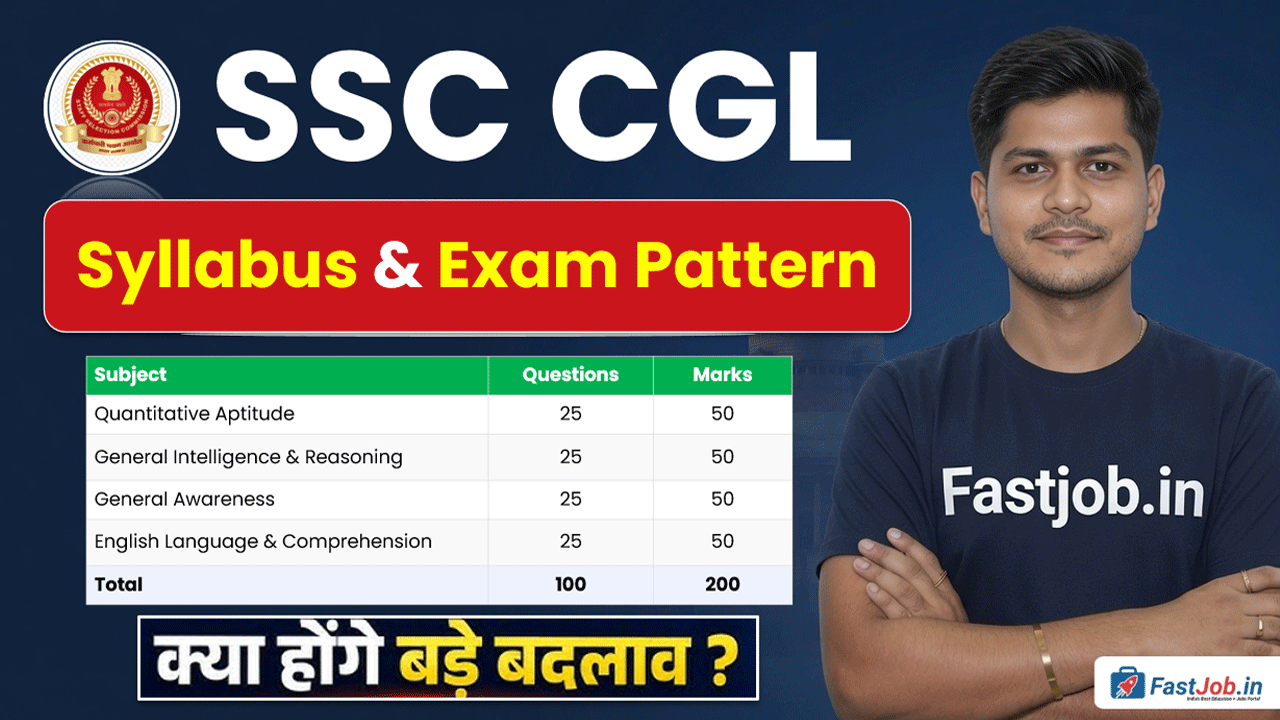
SSC CGL Syllabus 2026 Introduction: The SSC CGL Syllabus 2026 is divided into two tiers: Tier I (Qualifying Nature) and Tier II (Merit List Ranking).
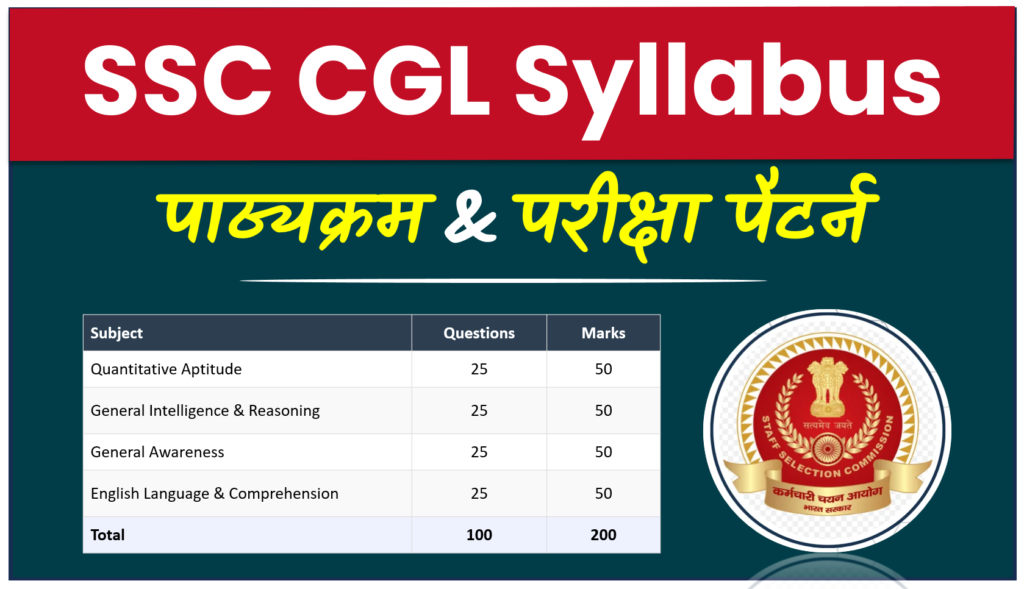
- SSC CGL Tier I covers four main subjects: General Intelligence and Reasoning, General Awareness, Quantitative Aptitude and English Comprehension.
- SSC CGL Tier II Paper I covers the important Subjects: Mathematical Abilities, Reasoning and General Intelligence in Section I, English Language and Comprehension and General Awareness in Section II, Computer Knowledge Test in Section III and Data Entry Speed Test in Section IV.
- SSC CGL Tier II Paper II covers the important Subjects: Statistics only for Junior Statistical Officer (JSO) Post, and SSC CGL Tier II Paper III includes General Studies (Finance and Economics) only for Assistant Audit Officer/ Assistant Accounts Officer Posts.
- Tier I follows a multiple-choice format, where candidates answer objective questions across all four subjects. Except for the English section, questions are available in both Hindi and English. Candidates should also keep the marking scheme in mind, as incorrect responses lead to score deductions.
- SSC CGL Tier I has negative marking of 0.50 marks for each wrong answer.
- SSC CGL Tier II (Paper-I, Paper-II & Paper-III) will consist of objective-type, multiple-choice questions, except for Section-IV of Paper-I. The questions will be set both in English & Hindi, except for the English Language and Comprehension Part in Section-II of Paper-I.
- SSC CGL Tier II negative marking is 1 mark for each wrong answer in Section I, Section II, and Section III of Paper I and 0.50 marks for each wrong answer in Paper II and Paper III.
Understanding the SSC CGL Syllabus 2026 is the first step toward building a smart preparation strategy for the SSC CGL Exam 2026.
Apart from the common subjects in the SSC CGL Syllabus, the SSC CGL Examination also includes specialised papers for selected posts.
Candidates applying for roles such as Junior Statistical Officer (JSO) or specific finance-related positions must prepare for additional subject requirements linked to their post preferences. A clear understanding of the latest SSC CGL Syllabus 2026 not only helps in identifying important topics but also makes it easier to create a focused study plan, improve revision, and prepare with better accuracy for the exam. So every student should know the full details of the SSC CGL Syllabus 2026. Also, the SSC CGL Syllabus PDF Free Download Link is given below.
What is SSC CGL Exam
The SSC CGL (Staff Selection Commission Combined Graduate Level) is one of India’s most prestigious and competitive examinations. Conducted by the Staff Selection Commission, this exam is held to recruit highly qualified candidates for various Group B and Group A (Non-Gazetted) posts in Indian government departments and ministries.
- SSC CGL Full Form: Staff Selection Commission, Combined Graduate Level
- Conducting Body: Staff Selection Commission (SSC)
- Exam Type: National Level Competitive Examination
- Posts: Group A and Group B positions
- Eligibility: Bachelor’s Degree from a recognized university
- Selection Process: Competitive, merit-based
- Frequency: Conducted once a year (usually)
- Number of Attempts: Limited based on age and category
- Job Security: Permanent government position with excellent benefits
Why the SSC CGL Exam is Popular
- Job Security: Permanent position in the government sector
- Attractive Salary: Competitive pay with allowances
- Benefits: Pension, medical, housing, travel benefits
- Prestige: High social status and recognition in Indian Society
- Work-Life Balance: Fixed working hours and holidays
- Career Growth: Opportunities for promotion and transfer
SSC CGL Syllabus 2026: Exam Overview 2026
| SSC CGL Eligibility Criteria 2026 | |
| Nationality | Indian citizen |
| SSC CGL Age Limit 2026 | General/OBC: 18-32 years | SC/ST: 18-37 years | Persons with Disability: 18-42 years |
| SSC CGL Qualification | Bachelor’s Degree in any stream from a recognized university |
| Physical Standards | As per SSC norms |
| SSC CGL Exam Date 2026 | |
| SSC CGL Official Website | https://ssc.gov.in/ |
SSC CGL Post List and Salary 2026
| SSC CGL Post List and Salary 2026 | |
| Assistant Audit Officer (AAO) | Basic Pay: ₹47,600 In-hand: ₹63,000-₹70,000 |
| Income Tax Inspector (ITI) | Basic Pay: ₹44,900 In-hand: ₹55,000-₹65,000 |
| Assistant Section Officer (ASO) | Basic Pay: ₹44,900/- In-hand: ₹55,000-₹65,000 |
| Excise Inspector | Basic Pay: ₹44,900 In-hand: ₹55,000-₹65,000 |
| Preventive Officer | Basic Pay: ₹44,900 In-hand: ₹55,000-₹65,000 |
| Assistant Enforcement Officer (AEO) | Basic Pay: ₹44,900 In-hand: ₹55,000-₹65,000 |
| Junior Statistical Officer (JSO) | Basic Pay: ₹44,900 In-hand: ₹55,000-₹65,000 |
| Sub-Inspector (CBI) | Basic Pay: ₹44,900 In-hand: ₹55,000-₹65,000 |
| Inspector (NIA) | Basic Pay: ₹44,900 In-hand: ₹55,000-₹65,000 |
| Inspector (CBN) | Basic Pay: ₹44,900 In-hand: ₹55,000-₹65,000 |
| Examiner | Basic Pay: ₹44,900 In-hand: ₹55,000-₹65,000 |
| Auditor | Basic Pay: ₹35,400 In-hand: ₹45,000-₹55,000 |
| Junior Accountant | Basic Pay: ₹35,400 In-hand: ₹45,000-₹55,000 |
| Accountant | Basic Pay: ₹35,400 In-hand: ₹45,000-₹55,000 |
| Assistant | Basic Pay: ₹35,400 In-hand: ₹45,000-₹55,000 |
| Tax Assistant | Basic Pay: ₹29,200 In-hand: ₹38,000-₹48,000 |
| Inspector of Post | Basic Pay: ₹29,200 In-hand: ₹38,000-₹48,000 |
| Upper Division Clerk (UDC) | Basic Pay: ₹25,500 In-hand: ₹33,000-₹42,000 |
| Lower Division Clerk (LDC) | Basic Pay: ₹25,500 In-hand: ₹33,000-₹42,000 |
| Data Entry Operator | Basic Pay: ₹25,500 In-hand: ₹33,000-₹42,000 |
| Postal Assistant | Basic Pay: ₹25,500 In-hand: ₹33,000-₹42,000 |
SSC CGL Exam Subjects List (2026)
If you are preparing for SSC CGL 2026, understanding the SSC CGL syllabus 2026 and CGL subject list is the first step toward effective preparation. The main SSC CGL exam subjects include Mathematics, Reasoning, English Language, and General Awareness (GK). Many aspirants search for terms like CGL exam subject list, CGL subjects, CGL subjects list, CGL exam syllabus, and CGL syllabus to understand the latest exam pattern and important topics. By studying the complete syllabus and focusing on high-weightage chapters, candidates can improve their chances of success in the SSC CGL examination. Tier 1 covers these four core subjects, while Tier 2 includes additional modules such as Computer Knowledge and Data Entry Skills.
Tier-1 Subjects
- General Intelligence & Reasoning
- General Awareness (GK/Current Affairs)
- Quantitative Aptitude (Maths)
- English Comprehension
Tier-1 consists of a total of 100 questions carrying 200 marks
Tier-2 Subjects
- Mathematical Abilities (Advanced Maths)
- Reasoning & General Intelligence
- English Language & Comprehension
- General Awareness
- Computer Knowledge Test
- Data Entry Speed Test (DEST) ⌨️ (Qualifying)
Some specific posts may require additional papers/examinations, such as:
- Statistics (for Junior Statistical Officer posts)
- Finance & Economics (for Assistant Audit Officer/Assistant Accounts Officer posts)
SSC CGL Selection Process 2026
SSC CGL Selection will be based on a Computer-Based Examination conducted in two tiers, as given below
- Tier-I
- Tier-II
SSC CGL Exam Pattern 2026
 Download Image
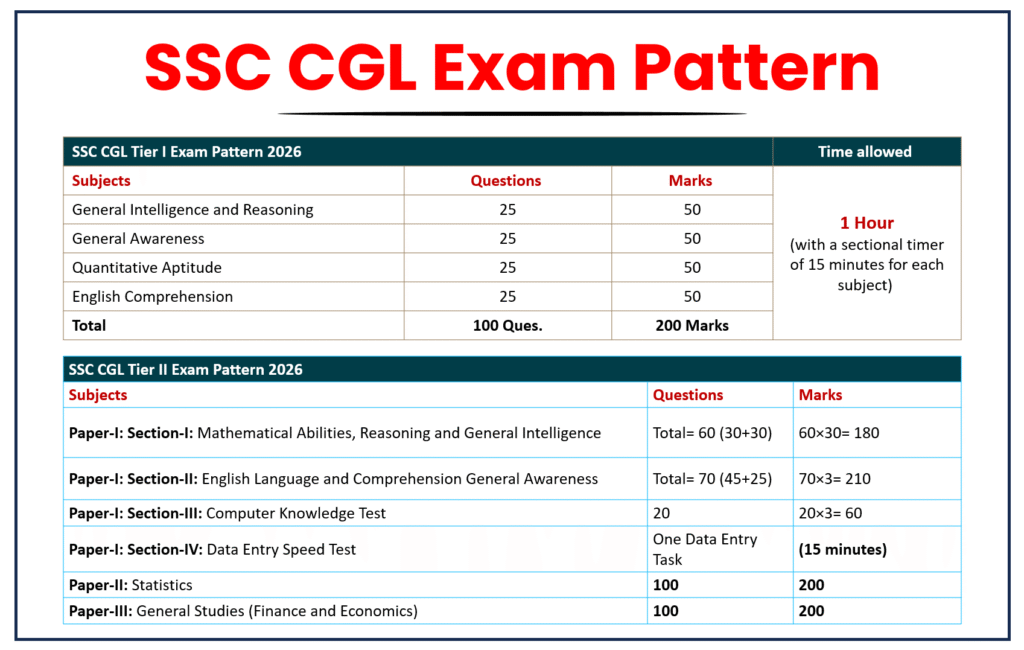
SSC CGL Tier I Exam Pattern 2026
| SSC CGL Tier I Exam Pattern 2026 | ||
| Subjects | Questions | Marks |
| General Intelligence and Reasoning | 25 | 50 |
| General Awareness | 25 | 50 |
| Quantitative Aptitude | 25 | 50 |
| English Comprehension | 25 | 50 |
| Total | 100 Ques. | 200 Marks |
| Time allowed | 1 hour (with a sectional timer of 15 minutes for each subject) | |
| Question Type | Tier I will consist of Objective-Type and Multiple-Choice questions. | |
| Question Paper Language | Both in English & Hindi, except for English Comprehension | |
| Negative Marking | 0.50 marks for each wrong answer | |
SSC CGL Tier 2 Pattern 2026
| SSC CGL Tier II Exam Pattern 2026 | ||
| Subjects | Questions | Marks |
| Paper-I: Section-I: Mathematical Abilities, Reasoning and General Intelligence | Total= 60 (30+30) | 60×30= 180 |
| Paper-I: Section-II: English Language and Comprehension General Awareness | Total= 70 (45+25) | 70×3= 210 |
| Paper-I: Section-III: Computer Knowledge Test | 20 | 20×3= 60 |
| Paper-I: Section-IV: Data Entry Speed Test | One Data Entry Task | (15 minutes) |
| Paper-II: Statistics | 100 | 200 |
| Paper-III: General Studies (Finance and Economics) | 100 | 200 |
Time | Paper-I: Section-I: 1 hour (with sectional timer of 30 minutes for each subject) Paper-II: Section-II: 1 hour (with sectional timer of 40 minutes for Subject A, i.e. English Language & Comprehension, and 20 minutes for Subject B, i.e. General Awareness) Section-III: 15 Minutes Session-II Section-IV: 15 Minutes Paper-II: 2 hours Paper-III: 2 hours | |
Negative Marking | There will be negative marking of 1 mark for each wrong answer in Section I, Section II, and Section III of Paper I and of 0.50 marks for each wrong answer in Paper II. | |
SSC CGL Minimum Qualification Marks 2026
| SSC CGL Tier 1 Qualifying Marks 2026 | ||
| SSC CGL Tier 1 Qualifying Marks for SC Category | 20% | |
| SSC CGL Tier 1 qualifying marks for ST Category | 20% | |
| SSC CGL Tier 1 Qualifying Marks for OBC | 25% | |
| SSC CGL Tier 1 Qualifying Marks for EWS | 25% | |
| SSC CGL Tier 1 Qualifying Marks for Unreserved Category | 30% | |
| SSC CGL Tier 2 Qualifying Marks 2026 | ||
| SSC CGL Tier 2 Qualifying Marks for SC Category | 20% | |
| SSC CGL Tier 2 qualifying marks for ST Category | 20% | |
| SSC CGL Tier 2 Qualifying Marks for OBC | 25% | |
| SSC CGL Tier 2 Qualifying Marks for EWS | 25% | |
| SSC CGL Tier 2 Qualifying Marks for Unreserved Category | 30% | |
| Maximum Percentage of Errors Allowed in Section-IV of Paper-I of Tier-II Examination, i.e. DEST, is as follows | ||
| UR | 20% | |
| OBC/ EWS | 25% | |
| All other categories | 30% | |
SSC CGL Syllabus 2026 Topic Wise
 Download Image
SSC CGL Syllabus Marks Wise
SSC CGL Tier-1 Syllabus 2026
| SSC CGL General Awareness Syllabus 2026 Tier 1 | |
| Topic | Questions |
| History of Ancient India (प्राचीन भारत का इतिहास) | 1-2 |
| History of Ancient India (प्राचीन भारत का इतिहास) | 1-2 |
| History of Medieval India (मध्यकालीन भारत का इतिहास) | 0-1 |
| History of Modern India (आधुनिक भारत का इतिहास) | 1-2 |
| World History (विश्व का इतिहास) | 0-1 |
| Arts and Culture (कला एवं संस्कृति) | 1-2 |
| Geography of India (भारत का भूगोल) | 1-2 |
| World Geography (विश्व का भूगोल) | 0-1 |
| Environment and Ecology (पर्यावरण और पारिस्थितिकी) | 1-2 |
| Indian Polity and Constitution (भारतीय राजव्यवस्था एवं संविधान) | 3-4 (Highest) |
| Indian Economy (भारतीय अर्थव्यवस्था) | 2-3 |
| Physics (भौतिक विज्ञान) | 1-2 |
| Chemistry (रसायन विज्ञान) | 1-2 |
| Biology (जीव विज्ञान) | 1-2 |
| Science and Technology (विज्ञान और प्रौद्योगिकी) | 1-2 |
| Static GK (सामान्य ज्ञान विविध): (Art, Dance, Music, Books, Awards, Important Days, Currency) | 5-7 |
Current Affairs (समसामयिकी): ● Government Schemes & Policies: 2-3 Questions ● Awards & Honours: 1-2 Questions ● Sports & Events: 1-2 Questions ● International Affairs: 1-2 Questions ● Appointments & Important Dates: 1-2 Questions ● Budget & Finance: 1-2 Questions ● National News: 2-3 Questions | 8-10 |
Preparation Strategy ● GK Priority Order: Polity >> Science >> History >> Geography >> Economy >> Miscellaneous ● Study Material: NCERT Class 6-12, Lucent’s GK, Indian Polity by M. Laxmikanth ● Time Distribution: 60% Static GK (one-time learning) | 40% Current Affairs (continuous updates) ● Daily Practice: 2-3 GK questions daily + Read newspapers for current affairs ● Revision: Weekly revision of static topics + Monthly current affairs summary | |
| SSC CGL English Syllabus 2026 Tier 1 | ||
| Topic | Questions | Marks |
| Reading Comprehension | 4-5 | 8-10 |
| Error Detection | 2-3 | 4-6 |
| Sentence Improvement | 1-2 | 2-4 |
| Cloze Test (Fill in Blanks) | 1-2 | 2-4 |
| Para Jumbles (Sentence Rearrangement) | 2-3 | 4-6 |
| Synonyms | 1-2 | 2-4 |
| Antonyms | 1-2 | 2-4 |
| Idioms & Phrases | 1-2 | 2-4 |
| One Word Substitution | 2-3 | 4-6 |
| Active-Passive Voice | 2-3 | 4-6 |
| Word Correction | 1-2 | 2-4 |
| Total | 25 | 50 |
High-Priority Topics: ● Reading Comprehension – 4-5 questions (Foundation topic) ● Vocabulary (Synonyms, Antonyms, One-Word Substitution) – 6-8 questions (Highest weightage) ● Error Detection – 2-3 questions (Regular pattern) ● Active-Passive Voice – 2-3 questions (Grammar basics) ● Para Jumbles – 2-3 questions (Logic-based) | ||
| SSC CGL Reasoning Syllabus 2026 Tier 1 | |
| Topic | Questions |
| Coding-Decoding | 2-4 |
| Number/Alphabetic Series | 2-4 |
| Analogy | 2-3 |
| Classification | 2-3 |
| Syllogism | 1-2 |
| Blood Relations | 1-2 |
| Direction Sense | 1-2 |
| Word Formation | 1-2 |
| Ranking/Order | 0-1 |
| Puzzle/Arrangement | 0-2 |
| Non-Verbal Reasoning | 4-5 |
| Miscellaneous | 1-2 |
High-Priority Topics: ● Non-Verbal Reasoning (4-5 Q) – Pattern & Figure-based ● Series (2-4 Q) – Number & Alphabetic patterns ● Coding-Decoding (2-4 Q) – Code breaking & formation ● Analogy (2-3 Q) – Relationship identification ● Classification (2-3 Q) – Odd one out & grouping | |
| SSC CGL Math Syllabus 2026 Tier 1 | |
| Topic | Questions |
Arithmetic (High-Weightage): ● Profit & Loss: 2-3 questions ● Time & Work: 2-3 questions ● Simple & Compound Interest: 2-3 questions ● Time, Speed & Distance: 2-3 questions ● Percentages: 1-2 questions ● Averages: 0-1 question ● Ratio & Proportion: 1-2 questions ● Mixtures: 0-1 question ● Age Problems: 0-1 question ● Boats & Streams: 0-1 question ● Whole Numbers & Fractions: 1-2 questions | 8-10 |
Geometry (2D & 3D figures): ● Properties of Circles ● Properties of Triangles ● Properties of Quadrilaterals ● Coordinate Geometry | 2-3 |
Mensuration: ● Area & Perimeter (Squares, Rectangles, Circles) ● Volume & Surface Area (Cubes, Cylinders, Cones, Spheres) | 3-4 |
| Algebra | 2-3 |
Trigonometry ● Trigonometric Ratios ● Trigonometric Identities ● Heights & Distances (Angle of Elevation/Depression) | 1-2 |
Data Interpretation ● Bar ● Graphs ● Pie Charts ● Line Graphs ● Tables | 2-4 |
Number System ● Whole Numbers ● Decimals & Fractions ● HCF & LCM ● Divisibility Rules ● Prime Numbers | 1-2 |
Miscellaneous ● Sequences & Series (AP, GP) ● Logarithms ● Set Theory | 1-2 |
High-Priority Topics: Master These First (70% of marks) ● Arithmetic Topics (8-10 Q):- Profit & Loss, Time & Work, SI/CI ● Geometry & Mensuration (4-6 Q): Circle, Triangle, Area, Volume ● Data Interpretation (2-4 Q): Charts & Graphs ● These 3 categories = 14-20 questions = 60-80% of the section | |
SSC CGL Tier 2 syllabus 2026
Part A of Section I of Paper I (Mathematical Abilities)
- Number Systems: Computation of Whole Numbers, Decimals and Fractions, Relationship between Numbers.
- Fundamental arithmetical operations: Percentages, Ratio and Proportion, Square roots, Averages, Interest (Simple and Compound), Profit and Loss, Discount, Partnership Business, Mixture and Alligation, Time and distance, Time and work.
- Algebra: Basic algebraic identities of School Algebra and Elementary surds (simple problems) and Graphs of Linear Equations.
- Geometry: Familiarity with elementary geometric figures and facts: Triangle and its various kinds of centres, Congruence and similarity of triangles, Circle and its chords, tangents, angles subtended by chords of a circle, common tangents to two or more circles.
- Mensuration: Triangle, Quadrilaterals, Regular Polygons, Circle, Right Prism, Right Circular Cone, Right Circular Cylinder, Sphere, Hemispheres, Rectangular Parallelepiped, Regular Right Pyramid with triangular or square Base.
- Trigonometry: Trigonometry, Trigonometric ratios, Complementary angles, Height and distances (simple problems only); standard identities like sin2𝜃 + cos2𝜃=1, etc.
- Statistics and probability: Use of Tables and Graphs: Histogram, Frequency polygon, Bar-diagram, Pie-chart; Measures of central tendency: mean, median, mode, standard deviation; calculation of simple probabilities.
Part B of Section-I of Paper-I (Reasoning and General Intelligence)
- Semantic Analogy (शाब्दिक सादृश्य)
- Symbolic Operations (प्रतीकात्मक संक्रियाएँ)
- Symbolic/Number Analogy (प्रतीकात्मक/संख्या सादृश्य)
- Trends (प्रवृत्तियाँ/रुझान)
- Figural Analogy (आकृति सादृश्य)
- Space Orientation (स्थान अभिविन्यास)
- Semantic Classification (शाब्दिक वर्गीकरण)
- Venn Diagrams (वेन आरेख)
- Symbolic/Number Classification (प्रतीकात्मक/संख्या वर्गीकरण)
- Drawing Inferences (निष्कर्ष निकालना)
- Figural Classification (आकृति वर्गीकरण)
- Punched Hole/Pattern-Folding & Unfolding (छिद्रित आकृति/पैटर्न मोड़ना एवं खोलना)
- Semantic Series (शाब्दिक श्रेणी)
- Figural Pattern-Folding and Completion (आकृति पैटर्न मोड़ना एवं पूर्ण करना)
- Number Series (संख्या श्रेणी)
- Embedded Figures (निहित आकृतियाँ)
- Figural Series (आकृति श्रेणी)
- Critical Thinking (आलोचनात्मक चिंतन)
- Problem Solving (समस्या समाधान)
- Emotional Intelligence (भावनात्मक बुद्धिमत्ता)
- Word Building (शब्द निर्माण)
- Social Intelligence (सामाजिक बुद्धिमत्ता)
- Coding and Decoding (कूट लेखन एवं अपकूट)
- Numerical Operations (संख्यात्मक संक्रियाएँ)
Part A of Section-II of Paper-I (English Language and Comprehension)
- Vocabulary (शब्दावली)
- Grammar (व्याकरण)
- Sentence Structure (वाक्य संरचना)
- Synonyms (पर्यायवाची शब्द)
- Antonyms (विलोम शब्द)
- Correct Usage (सही प्रयोग)
- Spot the Error (त्रुटि ढूँढना)
- Fill in the Blanks (रिक्त स्थान भरना)
- Synonyms/Homonyms (पर्यायवाची/समरूपी शब्द)
- Antonyms (विलोम शब्द)
- Spellings/Detecting Mis-spelt Words (वर्तनी/गलत वर्तनी पहचानना)
- Idioms & Phrases (मुहावरे और वाक्यांश)
- One-word Substitution (एक शब्द प्रतिस्थापन)
- Improvement of Sentences (वाक्यों में सुधार)
- Active/Passive Voice of Verbs (क्रियाओं का कर्तृवाच्य/कर्मवाच्य)
- Conversion into Direct/Indirect Narration (प्रत्यक्ष/परोक्ष कथन में रूपांतरण)
- Shuffling of Sentence Parts (वाक्यांशों की अदला-बदली)
- Shuffling of Sentences in a Passage (गद्यांश में वाक्यों की अदला-बदली)
- Cloze Passage (रिक्त गद्यांश)
- Comprehension Passage (बोध गद्यांश)
Part B of Section-II of Paper-I (General Awareness)
- History (भारत का इतिहास)
- Arts and Culture (कला एवं संस्कृति)
- Geography of India (भारत का भूगोल)
- World Geography (विश्व का भूगोल)
- Environment and Ecology (पर्यावरण और पारिस्थितिकी)
- Indian Polity and Constitution (भारतीय राजव्यवस्था एवं संविधान)
- Indian Economy (भारतीय अर्थव्यवस्था)
- Physics (भौतिक विज्ञान)
- Chemistry (रसायन विज्ञान)
- Biology (जीव विज्ञान)
- Science and Technology (विज्ञान और प्रौद्योगिकी)
- Static GK (सामान्य ज्ञान विविध)
- Current Affairs (समसामयिकी)
Section-III of Paper I (Computer Knowledge/ Proficiency)
- Computer Basics: Organization of a computer, Central Processing Unit (CPU), input/ output devices, computer memory, memory organization, back up devices, PORTs, Windows Explorer. Keyboard shortcuts.
- Software: Windows Operating system including basics of Microsoft Office like MS Word, MS Excel and Power Point etc.
- Working with Internet and e-mails: Web Browsing & Searching, Downloading & Uploading, Managing an E-mail Account, eBanking.
- Basics of networking and cyber security: Networking devices and protocols, Network and information security threats (like hacking, virus, worms, Trojan etc.) and preventive measures.
Paper-II (Statistics)
- Collection, Classification and Presentation of Statistical Data – Primary and Secondary data, Methods of data collection; Tabulation of data; Graphs and charts; Frequency distributions; Diagrammatic presentation of frequency distributions
- Measures of Central Tendency- Common measures of central tendency – mean median and mode; Partition values- quartiles, deciles, percentiles.
- Measures of Dispersion- Common measures dispersion – range, quartile deviations, mean deviation and standard deviation; Measures of relative dispersion.
- Moments, Skewness and Kurtosis – Different types of moments and their relationship; meaning of skewness and kurtosis; different measures of skewness and kurtosis.
- Correlation and Regression – Scatter diagram; simple correlation coefficient; simple regression lines; Spearman‟s rank correlation; Measures of association of attributes; Multiple regression; Multiple and partial correlation (For three variables only).
- Probability Theory – Meaning of probability; Different definitions of probability; Conditional probability; Compound probability; Independent events; Bayes’ theorem.
- Random Variable and Probability Distributions – Random variable; Probability functions; Expectation and Variance of a random variable; Higher moments of a random variable; Binomial, Poisson, Normal and Exponential distributions; Joint distribution of two random variable (discrete).
- Sampling Theory – Concept of population and sample; Parameter and statistic, Sampling and non-sampling errors; Probability and non-probability sampling techniques (simple random sampling, stratified sampling, multistage sampling, multiphase sampling, cluster sampling, systematic sampling, purposive sampling, convenience sampling and quota sampling); Sampling distribution (statement only); Sample size decisions.
- Statistical Inference – Point estimation and interval estimation, Properties of a good estimator, Methods of estimation (Moments method, Maximum likelihood method, Least squares method), Testing of hypothesis, Basic concept of testing, Small sample and large sample tests, Tests based on Z, t, Chi-square and F statistic, Confidence intervals.
- Analysis of Variance – Analysis of one-way classified data and two-way classified data.
- Time Series Analysis – Components of time series, Determination of trend component by different methods, Measurement of seasonal variation by different methods.
- Index Numbers – Meaning of Index Numbers, Problems in the construction of index numbers, Types of index numbers, Different formulae, Base shifting and splicing of index numbers, Cost of living Index Numbers, Uses of Index Numbers.
SSC CGL Imp Apply Link
| Events | Link |
|---|---|
| Syllabus PDF | Click Here |
| Notification | Click Here |
| Maths Notes | Download |
| Resume Templates | Download |
| Daily Latest Jobs | Click Here |
| Join Our WhatsApp Group | Join Here |
| Join Our Telegram Group | Join Here |
SSC CGL Topic Wise Weightage Tier 1 2026-27
 Download Image
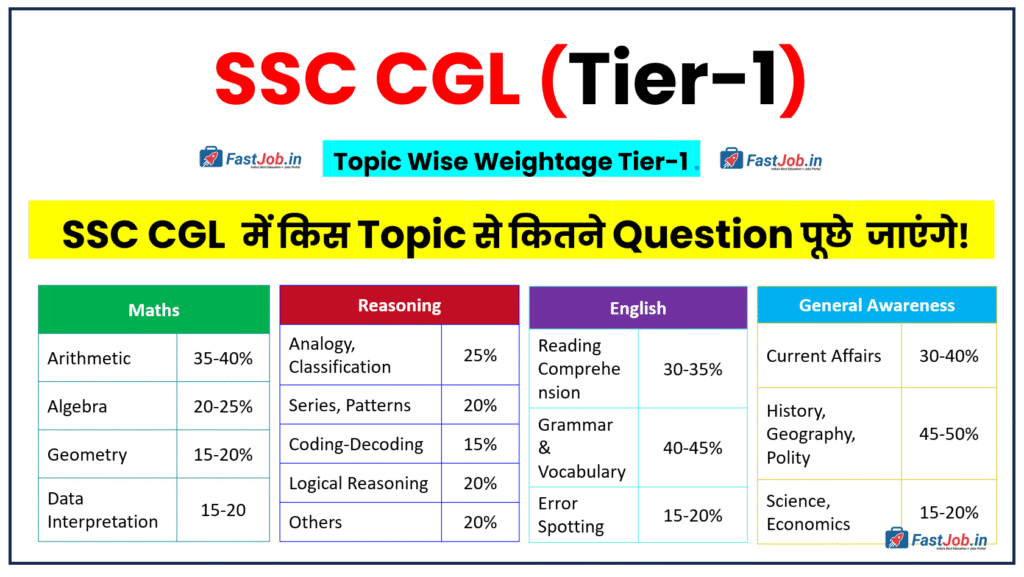
| SSC CGL Maths Topic Wise Weightage Tier 1 2026-27 | |
| Arithmetic | 35-40% |
| Algebra | 20-25% |
| Geometry | 15-20% |
| Data Interpretation | 15-20 |
| SSC CGL Reasoning Topic Wise Weightage Tier 1 2026-27 | |
| Analogy, Classification | 25% |
| Series, Patterns | 20% |
| Coding-Decoding | 15% |
| Logical Reasoning | 20% |
| Others | 20% |
| SSC CGL English Topic Wise Weightage Tier 1 2026-27 | |
| Reading Comprehension | 30-35% |
| Grammar & Vocabulary | 40-45% |
| Error Spotting | 15-20% |
| SSC CGL General Awareness Topic Wise Weightage Tier 1 2026-27 | |
| Current Affairs | 30-40% |
| History, Geography, Polity | 45-50% |
| Science, Economics | 15-20% |
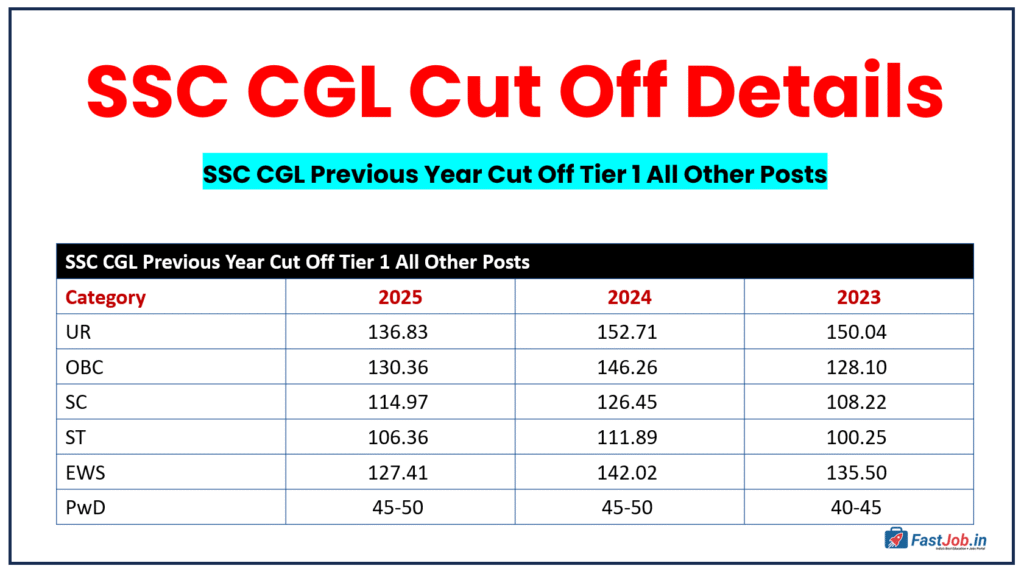
SSC CGL Cut Off Details
 Download Image
| SSC CGL Previous Year Cut Off Tier 1 All Other Posts | |||
| Category | 2025 | 2024 | 2023 |
| UR | 136.83 | 152.71 | 150.04 |
| OBC | 130.36 | 146.26 | 128.10 |
| SC | 114.97 | 126.45 | 108.22 |
| ST | 106.36 | 111.89 | 100.25 |
| EWS | 127.41 | 142.02 | 135.50 |
| PwD | 45-50 | 45-50 | 40-45 |
| SSC CGL Previous Year Cut Off Tier 1 JSO Posts | |||
| Category | 2025 | 2024 | 2023 |
| UR | 167.02 | 167.02 | 165 |
| OBC | 161.73 | 161.73 | 160 |
| SC | 160.65 | 160.65 | 158 |
| ST | 143.54 | 143.54 | 140 |
| EWS | 135.23 | 135.23 | 130 |
| SSC CGL Previous Year Cut Off Tier 1 SI Grade II | |||
| Category | 2025 | 2024 | 2023 |
| UR | 170-171 | 170.66 | 168 |
| OBC | 163-164 | 163.51 | 161 |
| SC | 161-162 | 161.13 | 159 |
| ST | 133-135 | 133 | 130 |
| EWS | 134-135 | 134.49 | 132 |
SSC CGL Previous Year Cut Off Tier 2
| Category | 2023 | 2024 |
|---|---|---|
| UR | 300 | 315 |
| OBC | 270 | 280 |
| SC | 230 | 240 |
| ST | 210 | 220 |
| Candidates Qualified | 85,000 | 88,051 |
SSC CGL Tier 1 Safe Score
| Category | Safe Score |
|---|---|
| SSC CGL Safe Score for UR Category | 145-150+ |
| SSC CGL Safe Score for OBC Category | 130-140 |
| SSC CGL Safe Score for SC Category | 115-125 |
| SSC CGL Safe Score for ST Category | 105-115 |
| SSC CGL Safe Score for EWS Category | 135-145 |
SSC CGL Books for Preparation
 Download Image
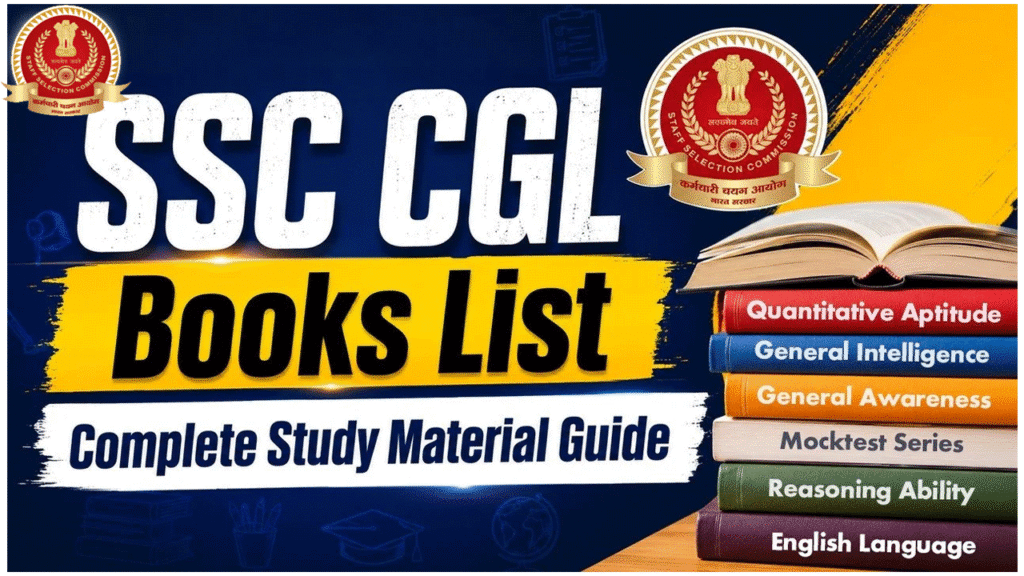
| SSC CGL Books |
General Intelligence & Reasoning: ● A Modern Approach to Verbal & Non-Verbal Reasoning, R.S. Aggarwal ● Analytical Reasoning – M.K. Pandey ● How to Prepare for Logical Reasoning for CAT – Arun Sharma |
Quantitative Aptitude: ● Quantitative Aptitude for Competitive Examinations – R.S. Aggarwal & S.P. Gupta ● NCERT Mathematics Class 10 & 12 ● Fast Track Objective Arithmetic – Rajesh Verma |
General Awareness: ● Lucent’s General Knowledge – Latest Edition ● Manorama Yearbook (Annual) ● Indian Polity – M. Laxmikanth ● NCERT Books (Class 9-12) – History, Geography, Science |
English: ● Objective General English – S.P. Bakshi ● English Grammar & Composition – Wren and Martin ● Word Power Made Easy – Norman Lewis |
SSC CGL Study Plan
 Download Image
| Month 1: Foundation Building Week 1-2: ● Complete General Intelligence basics (Analogy, Classification) ● Revise the fundamentals of Quantitative Aptitude ● Start English grammar from scratch ● Read current affairs of the last 3 months Week 3-4: ● Complete Reasoning (Coding, Blood Relations) ● Practice Arithmetic (Percentage, Average) ● Improve English vocabulary ● Study General Awareness topics (History, Polity) |
Month 2: Intermediate Practice Week 1-2: ● Solve 50+ questions daily from each section ● Practice Tier 1 section-wise tests ● Complete Quantitative Aptitude (all topics) ● Master English comprehension Week 3-4: ● Take 2 full-length mock tests ● Revise weak areas ● Stay updated with current affairs |
Month 3: Final Revision Week 1: ● Take 3-4 full-length mock tests ● Analyze performance ● Focus on weak areas ● Solve previous year papers Week 2-3: ● Intensive revision ● Quick reference notes ● Speed building exercises ● Stress management Week 4: ● Light revision only ● Solve previous papers ● Get 8 hours of sleep daily ● Mental preparation |
SSC CGL Tips & Tricks to Score High
 Download Image
General Intelligence Tips:
Analogy Questions:
- Note ALL possible relationships
- Look for less obvious connections
- Practice with various word categories
Reasoning Questions:
- Draw diagrams (blood relations, logical deduction)
- Don’t assume extra information
- Read very carefully
Figure-based Questions:
- Visualize mentally before viewing options
- Practice pattern recognition
- Solve daily for accuracy
Time-saving:
- Skip ambiguous questions initially
- Mark and come back later
- Trust your first instinct usually (80% of time)
Quantitative Aptitude Tips:
Data Interpretation:
- Read axes labels carefully
- Calculate rough values first
- Check calculations twice
Percentage & Ratio:
- Convert to fractions for quick calculation
- Use ratio shortcuts
- Practice the unitary method
Geometry & Trigonometry:
- Draw figures to scale
- Learn all formulas by heart
- Relate to real objects for clarity
Speed Building:
- Learn mental math techniques
- Practice approximation
- Use shortcuts
English Tips:
English Comprehension
- Read English newspapers and magazines
- Build vocabulary daily (10-15 words)
- Practice reading comprehension passages
- Focus on grammar fundamentals
- Improve pronunciation and understanding
SSC CGL Last Year Paper
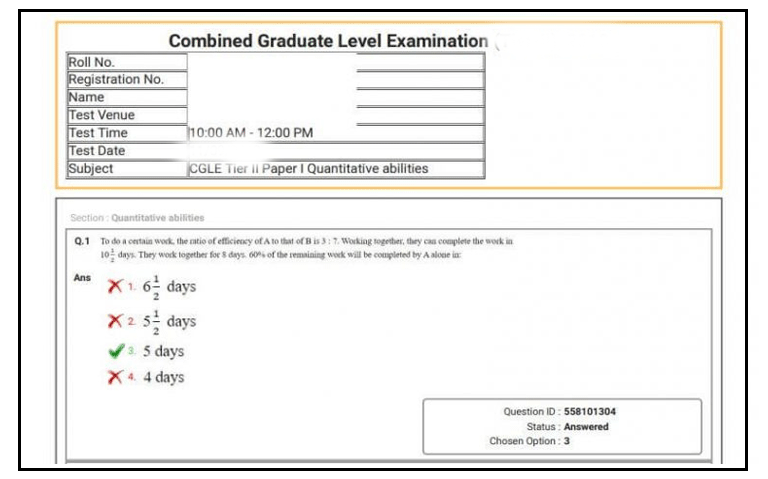 Download Image
| Year | Donload Link |
|---|---|
SSC CGL Time Table
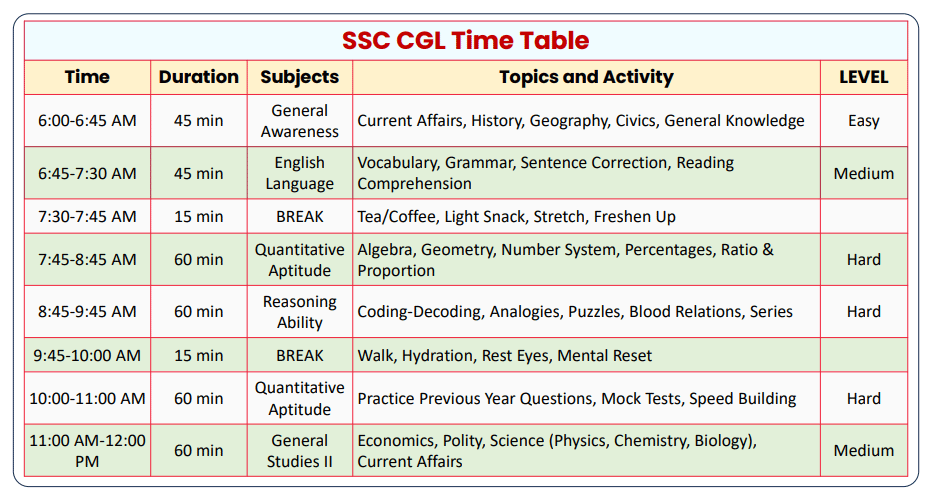 Download Image
SSC CGL Common Mistakes to Avoid
Over-dependence on One Source:
- Use multiple books and websites.
- Cross-verify information.
- Don’t stick to one approach
Neglecting Weak Areas:
- Identify weak topics early
- Give extra time to difficult areas
- Don’t skip topics entirely
Poor Time Management:
- Practice with a timer
- Don’t waste time on very difficult questions
- Allocate time section-wise
- Ignoring Negative Marking: Don’t guess randomly
- Attempt what you know
- Negative marking can cost heavily
Irregular Preparation:
- Study consistently 4-5 hours daily
- Don’t cram last minute
- Maintain discipline throughout
Not Taking Mock Tests:
- Take at least 20-30 full tests
- Analyze each test carefully
- Improve based on weaknesses
Skipping Previous Year Papers:
- Important for understanding patterns
- See recurring topics
- Practice time management
Poor Current Affairs Knowledge:
- This section is easy if prepared
- Read daily (just 30 minutes)
- Maintain a current affairs diary
SSC CGL Study Strategy Pro Tips & Time Management
- Total Study Hours: 8 hours | Breaks: 30 minutes
- Start with easier subjects (GA & English) to build confidence and momentum
- Tackle difficult subjects (Quant & Reasoning) when mental energy is highest
- Take short breaks every 90 minutes to maintain focus and prevent mental fatigue
- Use NCERT books, reliable study materials, and previous year question papers
- Solve at least 50 questions daily in Quantitative Aptitude to build speed
- Practice mock tests weekly to assess progress and identify weak areas
- Revise formulas, shortcuts, and important concepts daily before new topics
- Consistency is more important than long hours – follow this schedule daily
- Adjust timing based on your schedule, but maintain the subject sequence
- Track your progress weekly and adjust the difficulty level accordingly
SSC CGL Frequently Asked Questions (FAQs)
What is ssc cgl exam?
SSC CGL Exam is one of India’s most prestigious and competitive examinations. Conducted by the Staff Selection Commission, this exam is held to recruit highly qualified candidates for various Group B and Group A (Non-Gazetted) posts in Indian government departments and ministries.
How to prepare for SSC CGL?
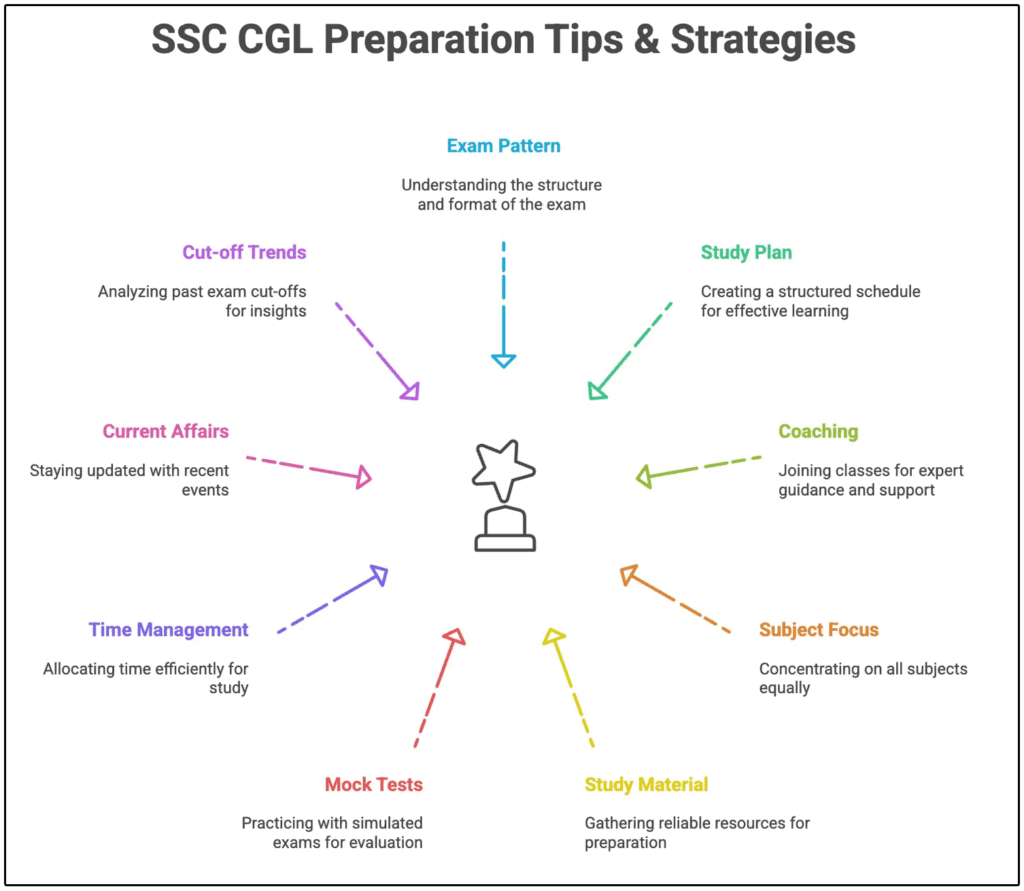
- Understand the Latest Syllabus & Exam Pattern: Begin by studying the SSC CGL Tier 1 and Tier 2 syllabi, marking schemes, and key topics.
- Create a Study Plan: Make a daily timetable based on your strengths and weaknesses. Allocate a fixed time to each subject.
- Strengthen Core Subjects: Focus on Quantitative Aptitude, Reasoning, English Language, General Awareness, and Computer Knowledge.
- Practice Maths & Reasoning Daily: Improve concepts, formulas, calculations, logical thinking, and problem-solving speed through regular practice.
- Improve English Skills: Work on grammar, vocabulary, reading comprehension, sentence correction, and error detection questions.
- Prepare General Awareness Smartly: Study static GK and revise important current affairs regularly.
- Solve Previous Year Papers (PYQs): Practice previous SSC CGL questions to understand the exam pattern, difficulty level, and frequently asked topics.
- Take Mock Tests Regularly: Attempt full-length mock tests to improve speed, accuracy, and time management.
- Analyze Your Mistakes: Review every mock test carefully and work on weak subjects or repeated errors.
- Stay Consistent & Disciplined: A balanced routine like 2 hrs Maths, 1–2 hrs English, 1 hr Reasoning, 1 hr GK, and daily mock practice can help candidates crack SSC CGL successfully, even in the first attempt.
How many attempts for SSC CGL?
There is no fixed limit on the number of attempts for SSC CGL. Candidates can appear for the exam multiple times as long as they meet the age limit, educational qualification, and other eligibility criteria for the post they are applying for. The effective number of attempts depends on factors such as age limit, category (General/OBC/SC/ST), and post-specific eligibility rules.
Does SSC CGL have interview?
No, SSC CGL does not have an interview stage for most posts. Selection is mainly based on Tier 1, Tier 2, and document verification. Candidates are selected according to their exam performance, cutoff marks, and post preferences. However, some posts may have additional requirements such as skill tests, computer proficiency tests, or physical standards tests, depending on the job role.
Is ssc cgl admit card out?
No, the SSC CGL Tier-1 admit card is not out yet. SSC usually releases the exam city slip/application status first, followed by the admit card a few days before the exam date on the official SSC website. Candidates should regularly check ssc.gov.in and their regional SSC website for the latest updates.
How to apply for SSC CGL?
To apply for SSC CGL, visit the official SSC website (ssc.gov.in) and complete the online application process. First, register yourself by creating an SSC account. Then, log in, select the SSC CGL application form, fill in your personal, educational, and communication details, upload the required documents, choose exam centres, and pay the application fee if applicable. Finally, submit the form and download the confirmation page for future reference.
How to download SSC CGL admit card?
To download the SSC CGL admit card, visit the official SSC website (ssc.gov.in) and go to the Admit Card/Login section. Log in using your Registration ID/OTR number and password or date of birth. Click on the SSC CGL Admit Card link for your exam tier, check your details, and download the hall ticket PDF. Candidates should also take a printout of the admit card for the exam day.
How many post in SSC CGL
SSC CGL offers recruitment for 30+ posts across various central government ministries, departments, and organizations. Popular SSC CGL posts include Income Tax Inspector, Assistant Section Officer (ASO), Assistant Audit Officer (AAO), Auditor, Accountant, Tax Assistant, Examiner, Central Excise Inspector, CBI Sub-Inspector, and Junior Statistical Officer (JSO). The exact number of posts and vacancies varies every year according to the official SSC CGL notification.
Is there interview in SSC CGL
No, SSC CGL does not have an interview stage. The interview process was removed in 2016 to make recruitment more transparent and objective. Selection is now based on Tier 1, Tier 2, document verification, and post-specific tests such as DEST, CPT, or physical/medical standards for certain posts.
How many candidates applied for SSC CGL 2023, 2024, 2025
- SSC CGL 2023: Around 24–26 lakh candidates applied for the exam, while approximately 8–9 lakh candidates appeared in Tier 1. Out of them, around 81,000+ candidates qualified for Tier 1 and became eligible for the next stage of the SSC CGL selection process.
- SSC CGL 2024: Around 34.8 lakh candidates applied for SSC CGL 2024, with nearly 18.1 lakh candidates appearing in Tier 1. Among them, approximately 1.65 lakh candidates qualified Tier 1 for the next stage.
- SSC CGL 2025: Around 28.1 lakh candidates applied for SSC CGL 2025, and nearly 13.5 lakh candidates appeared in Tier 1. Out of these, about 1.39 lakh candidates qualified for Tier 1 and advanced to the next stage of selection.
How many tier in SSC CGL?
SSC CGL currently has 2 tiers: Tier 1 and Tier 2. Tier 1 is a qualifying computer-based exam used for shortlisting candidates, while Tier 2 is the main scoring stage used for final merit and post-allocation. Some posts may also require skill tests, computer proficiency tests, or physical/medical standards after Tier 2.
How to check SSC CGL result?
To check the SSC CGL result, visit the official SSC website (ssc.gov.in) and open the “Results” section. Select the “CGL” tab and click on the relevant Tier 1 or Tier 2 result link. Download the result PDF and use Ctrl + F to search your roll number or name. If your details appear in the list, you have qualified for the next stage or final selection.
How to crack SSC CGL?
To crack SSC CGL, start by understanding the latest syllabus and exam pattern. Build strong concepts in Maths, Reasoning, English, and General Awareness, and prepare Tier 1 and Tier 2 together. Solve previous year papers (PYQs), take regular mock tests, and analyze your mistakes to improve speed and accuracy.
Is there any interview in SSC CGL?
No, there is no interview in SSC CGL. The interview stage was removed in 2016 to make the recruitment process more transparent and merit-based. Selection is now based on Tier 1, Tier 2, document verification, and post-specific tests such as DEST/CPT, physical tests, or medical standards for certain posts.
What are the posts in SSC CGL?
SSC CGL recruits candidates for 30+ Group B and Group C posts in central government ministries, departments, and organizations. Popular SSC CGL posts include Assistant Section Officer (ASO), Assistant Audit Officer (AAO), Assistant Accounts Officer (AAO), Income Tax Inspector, Central Excise Inspector, Examiner, Preventive Officer, CBI Sub-Inspector, Assistant Enforcement Officer, Junior Statistical Officer (JSO), Auditor, Accountant, Tax Assistant, Postal Assistant, and Divisional Accountant. The available posts and vacancies vary each year according to the official SSC notification.
Is there any interview in SSC CGL
Yes, SSC CGL has an interview round. It is the final stage of the selection process after qualifying for the Tier-1 and Tier-2 exams.
Is IGNOU degree valid for SSC CGL
Yes, IGNOU (Indira Gandhi National Open University) degrees are valid for the SSC CGL exam. However, the degree must be recognized by the government.
Can I crack SSC CGL in 3 months?
Yes, it is possible to crack SSC CGL in 3 months, but it requires intense, focused preparation.
- Daily Study Hours: 6-8 hours minimum
- Previous Knowledge: A good foundation in the basics helps
- Smart Strategy: Focus on high-weight topics
- Practice: 3-4 hours daily, mock tests and previous year questions
- Consistency: No skipping days
How to start preparation for SSC CGL
- Understand the SSC CGL syllabus and exam pattern before starting your preparation.
- Begin with core subjects: Maths, Reasoning, English, and General Awareness.
- Create a daily study timetable based on your strengths and weak areas.
- Start with basic concepts, especially in Maths and English.
- Solve previous year question papers (PYQs) to understand question trends and difficulty level.
- Take regular mock tests to improve speed, accuracy, and time management.
- Make short notes for revision and revise important topics consistently.
- Stay disciplined and consistent, as regular practice is the key to cracking SSC CGL.
Can appearing candidate apply for SSC CGL
Yes, appearing or final-year graduation candidates can apply for SSC CGL, provided they complete their bachelor’s degree before the cutoff date mentioned in the official notification. Candidates must produce proof of graduation during document verification. If the required qualification is not completed by the specified date, the candidature may be cancelled.
How many people appear for SSC CGL
SSC CGL attracts lakhs of candidates every year, making it one of India’s largest government exams. On average, around 15–18 lakh candidates appear for the SSC CGL Tier-1 exam annually, although the number changes each year. For example, around 18.1 lakh candidates appeared in SSC CGL 2024 Tier-1, while approximately 13.5 lakh candidates appeared in SSC CGL 2025 Tier-1.
Can graduation appearing apply for SSC CGL
Yes, graduation appearing (final-year) candidates can apply for SSC CGL, provided they complete their bachelor’s degree before the educational qualification cutoff date mentioned in the official notification. Candidates must submit valid proof of graduation during document verification. If the degree result is not declared by the required date, the candidate may become ineligible for SSC CGL selection.
Can I crack SSC CGL in 6 months?
Yes, you can crack SSC CGL in 6 months with a smart study plan, consistent practice, and proper revision. Focus on Maths, Reasoning, English, and General Awareness, and prepare Tier 1 and Tier 2 together. Solve previous year papers (PYQs), take regular mock tests, and analyze mistakes to improve speed and accuracy. A disciplined 5–8 hours daily study routine can be enough for many candidates, depending on their current preparation level.
Does SSC CGL have interview?
No, SSC CGL does not have an interview stage. The interview process was removed in 2016 to make recruitment more transparent and merit-based. Selection is mainly based on Tier 1, Tier 2, and document verification. However, some posts may require skill tests, computer proficiency tests, physical standards, or medical examinations, depending on the job role.
Is there interview in SSC CGL
No, there is no interview in SSC CGL. The interview stage was removed by SSC in 2016 for most posts. Selection is now based on Tier 1, Tier 2, and document verification. Some posts may also have skill tests, computer proficiency tests, physical tests, or medical standards, depending on the post requirements.
How many tier in SSC CGL
SSC CGL currently has 2 tiers: Tier 1 and Tier 2. Tier 1 is a qualifying computer-based exam used to shortlist candidates, while Tier 2 is the main scoring stage used for final merit and post-allocation. Some posts may also require skill tests, computer proficiency tests, physical standards, or medical examinations after Tier 2, depending on the post requirements.
Is there sectional cutoff in SSC CGL
No, SSC CGL generally does not have a sectional cutoff. Candidates are not required to score minimum marks in each subject separately such as Maths, English, Reasoning, or General Awareness. Selection is mainly based on the overall cutoff score and category-wise/post-wise cutoffs released by SSC. However, candidates must still aim for balanced performance across all sections to achieve a competitive total score.
What is the age limit for SSC CGL?
The SSC CGL age limit varies by post, but it generally ranges from 18 to 32 years. Depending on the post, common age brackets include 18–27 years, 18–30 years, 20–30 years, and 18–32 years. Reserved category candidates get age relaxation as per government rules, such as 3 years for OBC and 5 years for SC/ST candidates. Candidates should check the official SSC notification for post-wise age criteria before applying.
How many attempts for SSC CGL
There is no fixed limit on the number of attempts for SSC CGL. Candidates can appear for the exam multiple times as long as they satisfy the age limit, educational qualification, and other eligibility conditions for the post. The practical number of attempts depends on factors such as age, category (General/OBC/SC/ST), and post-wise age criteria. Reserved category candidates may get more attempts due to the age relaxation rules.
How to crack SSC CGL in first attempt
- To crack SSC CGL in the first attempt, start by understanding the latest syllabus and exam pattern. Prepare Tier 1 and Tier 2 together and focus on core subjects like Maths, Reasoning, English, and General Awareness. Build strong concepts first, then practice regularly.
- Solve previous year papers (PYQs) to understand important topics and question trends. Take regular mock tests to improve speed, accuracy, and time management. Analyze your mistakes after every test and work on weak areas.
- Use limited but quality study materials, make short notes for revision, and maintain a consistent study routine. With smart planning, disciplined revision, and daily practice, many candidates successfully crack the SSC CGL in their first attempt.
How many candidates applied for SSC CGL 2023
Around 24.74 lakh candidates (24,74,030) applied for SSC CGL 2023, making it one of India’s largest government recruitment exams. Out of these, about 12.36 lakh candidates appeared in Tier-1, while around 81,752 candidates qualified for the next stage of the selection process.
Can 12th pass apply for SSC CGL?
No, 12th-pass candidates cannot apply for SSC CGL because it is a graduate-level examination. To be eligible for SSC CGL, candidates must have a bachelor’s degree from a recognized university. Students who are currently in graduation or completing their final year may apply if they meet the qualification deadline mentioned in the official notification.
Can I give ssc cgl exam after 12th
No, you cannot directly give the SSC CGL exam after 12th pass because SSC CGL is a graduate-level examination. To be eligible, candidates must have a bachelor’s degree from a recognized university.
After 12th, you can first complete your graduation (BA, BSc, BCom, BTech, or any recognized degree) and then apply for SSC CGL. If you want an SSC exam immediately after 12th, you can consider exams like SSC CHSL or SSC MTS.
Is SSC CGL tough?
Yes, SSC CGL is a tough exam, but not impossible. It requires consistent preparation, smart strategy, and strong fundamentals. It’s one of India’s most competitive exams.
Why SSC CGL is Tough?
1. Massive Competition:
- 15-20 lakh candidates appear
- Only 3000-5000 selected
- Selection rate: 0.02-0.03%
- Tougher than IIT-JEE in terms of selection ratio
2. Exam Difficulty:
- Questions are tricky, not just concept-based
- Time management is crucial
- Requires speed AND accuracy
- Sectional cutoff eliminates many candidates
3. Multiple Selection Stages:
- Tier-1 (Objective MCQs)
- Tier-2 (More descriptive, harder questions)
- Tier-3 (Interview)
- Document verification
- All stages have their own difficulty
4. Varied SSC CGL Syllabus:
- General Knowledge is unpredictable
- Current affairs knowledge required
- Multiple subjects to master
- Deep understanding needed, not superficial learning
5. Inconsistent Cutoffs:
- Changes yearly based on difficulty
- Can increase or decrease unpredictably
- Hard to predict the target score
SSC CGL Syllabus 2026 Conclusion
Remember, lakhs of students appear for SSC CGL every year, and thousands succeed. With determination, smart preparation, and this comprehensive guide, you can be among the successful candidates. Start your preparation today with the conviction that success is inevitable with the right effort!
| SSC CGL Syllabus 2026 Tags | |
| SSC CGL Syllabus | SSC CGL Syllabus 2026 |
| SSC CGL Syllabus PDF | SSC CGL Syllabus PDF Free Download |
| SSC CGL Syllabus 2026 PDF Download in English | SSC CGL Syllabus in Hindi |
| SSC CGL Syllabus 2026 Pdf Free Download | SSC CGL Syllabus PDF Free Download 2026 |
| SSC CGL Syllabus in Hindi PDF | SSC CGL Syllabus 2026 |
| SSC CGL Syllabus PDF Free Download in Hindi | SSC CGL Syllabus 2026 Tier 1 |
| SSC CGL Syllabus Maths | SSC CGL Syllabus PDF Download |
| SSC CGL Syllabus 2026 PDF Download in English | SSC CGL Syllabus 2026 Tier 1 PDF Download |
| SSC CGL Syllabus English | SSC CGL Syllabus Books |
| What is SSC CGL Syllabus | SSC CGL Syllabus PDF in Hindi |
| SSC CGL Syllabus Download | Reasoning SSC CGL Syllabus |
| SSC CGL Syllabus Topic Wise | Tier 1 SSC CGL Syllabus |
| SSC CGL Syllabus with Weightage | PDF SSC CGL Syllabus |
| SSC CGL Syllabus Details | SSC CGL Syllabus Detailed |
