
SSC CHSL Syllabus 2026: New Exam Pattern, Chapter-Wise Weightage & PDF Download
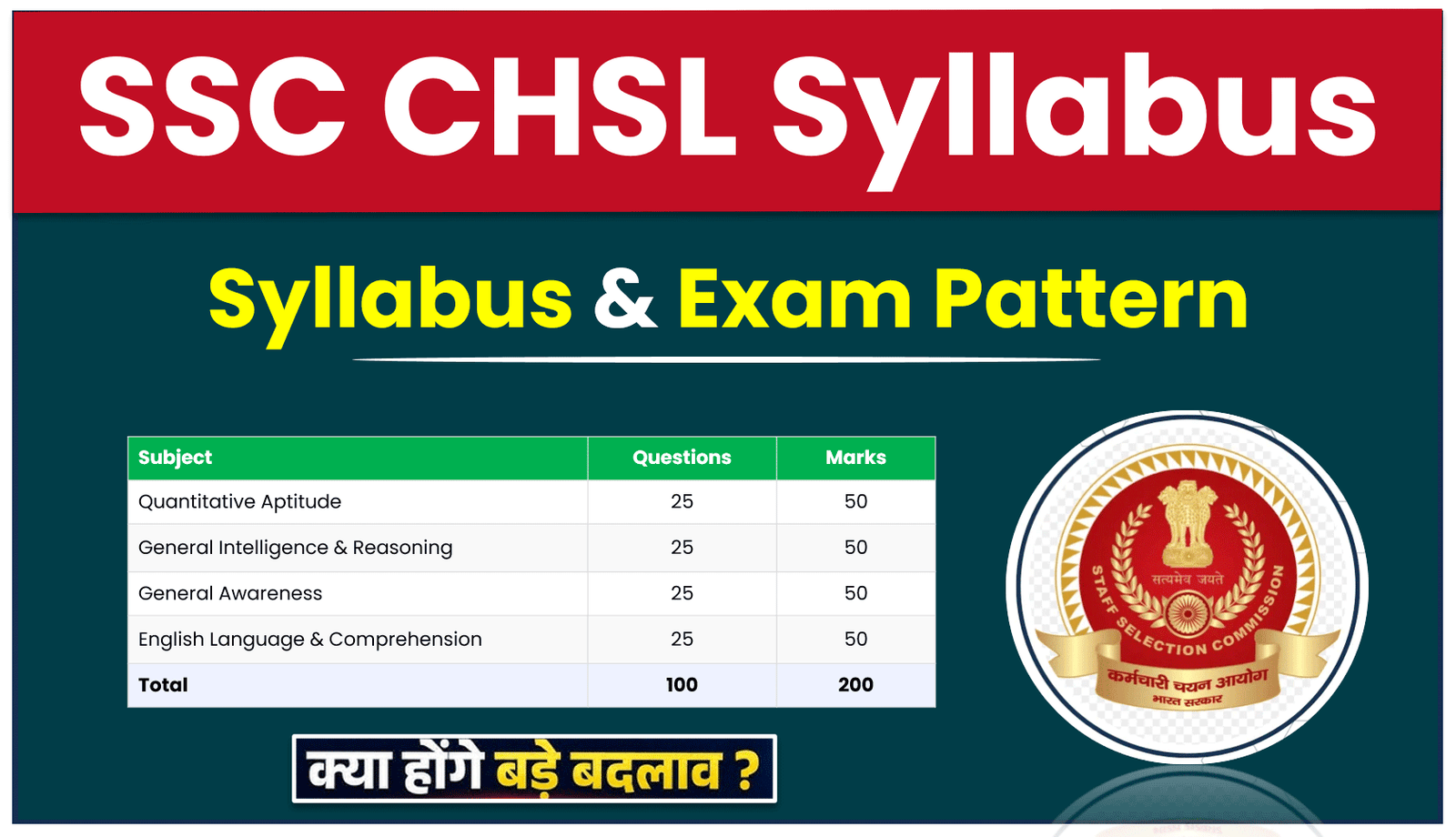
SSC CHSL Syllabus 2026 Introduction: The SSC CHSL Syllabus 2026 is divided into two tiers: Tier-I and Tier-II. Tier-I covers four subjects—English Language, General Intelligence, Quantitative Aptitude, and General Awareness. The Tier-I examination consists of 100 questions carrying 200 marks, with a total duration of 60 minutes. Tier-II includes Mathematical Abilities, Reasoning and General Intelligence, English Language and Comprehension, General Awareness, and Computer Knowledge, along with a Skill Test/Typing Test for the respective posts. The objective sections of Tier-II are conducted in different modules, while the Skill Test/Typing Test is qualifying in nature.
Understanding the SSC CHSL Syllabus 2026 is the first step toward building a smart preparation strategy for the SSC CHSL Exam 2026. Apart from the common subjects in the SSC CHSL Syllabus, the SSC CHSL Examination also includes specialized papers for selected posts. A clear understanding of the latest SSC CHSL Syllabus 2026 not only helps in identifying important topics but also makes it easier to create a focused study plan, improve revision, and prepare with better accuracy for the exam. So every student should know the full details of the SSC CHSL Syllabus 2026. Also, the SSC CHSL Syllabus PDF Free Download Link is given below.
What is the SSC CHSL Exam
The SSC CHSL (Staff Selection Commission Combined Higher Secondary (10+2) Level) is a national-level competitive examination conducted by the Staff Selection Commission (SSC) to recruit eligible candidates for various Group C posts in central government ministries, departments, and offices.
The examination offers candidates an opportunity to secure government positions after completing their 12th standard.
- SSC CHSL Full Form: Staff Selection Commission Combined Higher Secondary (10+2) Level
- Conducting Body: Staff Selection Commission (SSC)
- Exam Type: National-level competitive examination
- Posts: Lower Division Clerk (LDC)/Junior Secretariat Assistant (JSA), Data Entry Operator (DEO), and related Group C posts
- Eligibility: 12th Standard or equivalent qualification from a recognized board
- Selection Process: Tier-I, Tier-II, and Skill Test/Typing Test, as applicable
- Frequency: Generally conducted once a year
- Number of Attempts: No fixed limit; candidates can apply until they exceed the prescribed age limit
- Job Security: Central Government employment with salary, allowances, and other benefits
Why SSC CHSL is Popular
- Job Security: Stable and secure career in the Central Government sector
- Attractive Salary: Competitive salary with applicable allowances and benefits
- Government Benefits: Access to various allowances, medical facilities, leave benefits, and other government perks
- Prestige: Opportunity to work in reputed Central Government ministries, departments, and offices
- Work-Life Balance: Generally structured working hours with government holidays and leave benefits
- Career Growth: Opportunities for promotions, departmental examinations, and career advancement within the government sector
SSC CHSL Exam Overview
| SSC CHSL Eligibility Criteria 2026 | |
| Nationality | Indian citizen |
| SSC CHSL Age Limit 2026 | General/OBC: 18-32 years | SC/ST: 18-37 years | Persons with Disability: 18-42 years |
| SSC CHSL Qualification | 12th Pass in any stream from a recognized university |
| Physical Standards | As per SSC norms |
| SSC CHSL Exam Date 2026 | |
| SSC CHSL Official Website | https://ssc.gov.in/ |
SSC CHSL Post List and Salary 2026
- LDC / JSA: Level 2 — ₹30,000 – ₹35,000 per month
- DEO: Level 4 — ₹38,000 – ₹45,000 per month
- DEO: Level 5 — ₹42,000 – ₹50,000 per month
- DEO, Grade ‘A’: Level 4 — ₹38,000 – ₹45,000 per month
SSC CHSL Selection Process 2026
SSC CHSL Selection will be based on a Computer-Based Examination conducted in two tiers, as given below
- Tier-I
- Tier-II
SSC CHSL Exam Pattern 2026
| SSC CHSL Tier I Exam Pattern 2026 | ||
| Subjects | Questions | Marks |
| English Language(Basic Knowledge) | 25 | 50 |
| General Intelligence | 25 | 50 |
| Quantitative Aptitude (Basic Arithmetic Skill) | 25 | 50 |
| General Awareness | 25 | 50 |
| Total | 100 Ques. | 200 Marks |
| Time allowed | 60 Minutes (with a sectional timer of 15 minutes for each subject) | |
| Question Type | Tier I will consist of Objective-Type and Multiple-Choice questions. | |
| Question Paper Language | Both in English & Hindi, except for English Comprehension | |
| Negative Marking | 0.50 marks for each wrong answer | |
| SSC CHSL Tier II Exam Pattern 2026 | ||
| Subjects | Questions | Marks |
| Session-I (2 hours and 15 minutes) | ||
| Section-I: A: Mathematical Abilities | 30 | 90 |
| Section-I: B: Reasoning and General Intelligence | 30 | 90 |
| Section-I: Time | 1 hour (with sectional timer of 30 minutes each for Mathematical Abilities and Reasoning and General Intelligence) | |
| Section-II: A: English Language and Comprehension | 40 | 120 |
| Section-II: B: General Awareness | 20 | 60 |
| Section-I: Time | 1 hour (with sectional timer of 40 minutes for Subject A, i.e. English Language & Comprehension, and 20 minutes for Subject B, i.e. General Awareness) | |
| Section-III: Computer Knowledge Test | 15 | 45 |
| Session-II Section-IV: Skill Test/Typing Test | ||
| Subjetcts | Time | |
| Part A: Skill Test for DEOs in Department/ Ministry mentioned at Para 8.1 | 15 Minutes | |
| Part B: Skill Test for DEOs except in Department/ Ministry mentioned at Para 8.1 | 15 Minutes | |
| Part C: Typing Test for LDC/JSA | 10 Minutes | |
Note Part A – Skill Test for the post of DEO/ DEO Grade ‘A’ in Department/ Ministry mentioned at Para 8.1: The speed of 15000 (Fifteen Thousand) Key Depressions per hour on Computer‟ Part B – Skill Test for the post of DEO/ DEO Grade ‘A’ except in Department/ Ministry mentioned at Para 8.1: „Data Entry Speed of 8,000 (Eight Thousand) Key Depressions per hour on Computer‟ will be adjudged based on the correct entry of words/ key depressions as per the given passage. Part C – Typing Test for other posts i.e. LDC/ JSA: The medium of Typing Test will be Hindi or English. Typing speed of 35 words per minute (w.p.m.) and those opting for Hindi medium should have typing speed of 30 words per minute (w.p.m.). 35 w.p.m. and 30 w.p.m. correspond to about 10500 key depressions per hour and about 9000 key depressions per hour, respectively. | ||
SSC CHSL Minimum Qualification 2026
| SSC CHSL Tier 1 Qualifying Marks 2026 | ||
| SSC CHSL Qualifying Marks for SC Category | 20% | |
| SSC CHSL qualifying marks for ST Category | 20% | |
| SSC CHSL Qualifying Marks for OBC | 25% | |
| SSC CHSL Qualifying Marks for EWS | 25% | |
| SSC CHSL Qualifying Marks for Unreserved Category | 30% | |
SSC CHSL Syllabus 2026
SSC CHSL Syllabus 2026 for Tier-I
SSC CHSL Syllabus English Language 2026:
- Spot the Error
- Fill in the Blanks
- Synonyms/ Homonyms
- Antonyms, Spellings/ Detecting mis-spelt words
- Idioms & Phrases
- One-word substitution
- Improvement of Sentences
- Active/ Passive Voice of Verbs
- Conversion into Direct/ Indirect narration
- Shuffling of Sentence parts, Shuffling of Sentences in a passage
- Cloze Passage
- Comprehension Passage.
SSC CHSL Syllabus 2026: General Awareness
- Static GK (सामान्य ज्ञान विविध)
- Current Affairs (समसामयिकी)
- Science and Technology (विज्ञान और प्रौद्योगिकी)
- Physics (भौतिक विज्ञान)
- Chemistry (रसायन विज्ञान)
- Biology (जीव विज्ञान)
- Indian History (भारत का इतिहास)
- World History (विश्व का इतिहास)
- Arts and Culture (कला एवं संस्कृति)
- Geography of India (भारत का भूगोल)
- World Geography (विश्व का भूगोल)
- Environment and Ecology (पर्यावरण और पारिस्थितिकी)
- Indian Polity and Constitution (भारतीय राजव्यवस्था एवं संविधान)
- Indian Economy (भारतीय अर्थव्यवस्था)
SSC CHSL Syllabus 2026: General Intelligence
- Semantic Analogy
- Symbolic operations
- Symbolic/ Number Analogy
- Trends, Figural Analogy
- Space Orientation
- Semantic Classification
- Venn Diagrams
- Symbolic/ Number Classification
- Drawing inferences
- Figural Classification
- Punched hole/ pattern-folding & unfolding
- Semantic Series
- Figural Pattern-folding and completion
- Number Series
- Embedded figures
- Figural Series
- Critical Thinking
- Problem Solving
- Emotional Intelligence
- Word Building
- Social Intelligence
- Coding and de-coding
- Numerical operations
SSC CHSL Syllabus 2026: Quantitative Aptitude
- Number Systems: Computation of Whole Number, Decimal and Fractions, Relationship between numbers.
- Fundamental arithmetical operations: Percentages, Ratio and Proportion, Square roots, Averages, Interest (Simple and Compound), Profit and Loss, Discount, Partnership Business, Mixture and Alligation, Time and distance, Time and work.
- Algebra: Basic algebraic identities of School Algebra and Elementary surds (simple problems) and Graphs of Linear Equations.
- Geometry: Familiarity with elementary geometric figures and facts: Triangle and its various kinds of centres, Congruence and similarity of triangles, Circle and its chords, tangents, angles subtended by chords of a circle, common tangents to two or more circles.
- Mensuration: Triangle, Quadrilaterals, Regular Polygons, Circle, Right Prism, Right Circular Cone, Right Circular Cylinder, Sphere, Hemispheres, Rectangular Parallelepiped, Regular Right Pyramid with triangular or square Base.
- Trigonometry: Trigonometry, Trigonometric ratios, Complementary angles, Height and distances (simple problems only), Standard Identities like sin2𝜃 + Cos2𝜃=1 etc.
- Statistical Charts: Use of Tables and Graphs: Histogram, Frequency polygon, Bar diagram, Pie chart.
SSC CHSL Syllabus 2026 for Tier-II
SSC CHSL Syllabus 2026: Mathematical Abilities
- Number Systems: Computation of Whole Number, Decimal and Fractions, Relationship between numbers.
- Fundamental arithmetical operations: Percentages, Ratio and Proportion, Square roots, Averages, Interest (Simple and Compound), Profit and Loss, Discount, Partnership Business, Mixture and Alligation, Time and distance, Time and work.
- Algebra: Basic algebraic identities of School Algebra and Elementary surds (simple problems) and Graphs of Linear Equations.
- Geometry: Familiarity with elementary geometric figures and facts: Triangle and its various kinds of centres, Congruence and similarity of triangles, Circle and its chords, tangents, angles subtended by chords of a circle, common tangents to two or more circles.
- Mensuration: Triangle, Quadrilaterals, Regular Polygons, Circle, Right Prism, Right Circular Cone, Right Circular Cylinder, Sphere, Hemispheres, Rectangular Parallelepiped, Regular Right Pyramid with triangular or square Base.
- Trigonometry: Trigonometry, Trigonometric ratios, Complementary angles, Height and distances (simple problems only), Standard Identities like sin2𝜃 + Cos2𝜃=1 etc.
- Statistics and probability: Use of Tables and Graphs: Histogram, Frequency polygon, Bar-diagram, Pie-chart; Measures of central tendency: mean, median, mode, standard deviation; calculation of simple probabilities.
SSC CHSL Syllabus 2026: Reasoning and General Intelligence
- Semantic Analogy
- Symbolic operations
- Symbolic/ Number Analogy
- Trends, Figural Analogy
- Space Orientation
- Semantic Classification
- Venn Diagrams
- Symbolic/ Number Classification
- Drawing inferences
- Figural Classification
- Punched hole/ pattern-folding & unfolding
- Semantic Series
- Figural Pattern-folding and completion
- Number Series, Embedded figures, Figural Series
- Critical Thinking
- Problem Solving, Emotional Intelligence
- Word Building
- Social Intelligence
- Coding and decoding, Numerical operations
SSC CHSL Syllabus 2026: English Language and Comprehension
- Vocabulary
- Grammar
- Sentence structure
- Synonyms, Antonyms and their correct usage
- Spot the Error
- Fill in the Blanks
- Synonyms/ Homonyms
- Antonyms
- Spellings/ Detecting mis-spelt words
- Idioms & Phrases
- One-word substitution
- Improvement of Sentences
- Active/ Passive Voice of Verbs
- Conversion into Direct/ Indirect narration
- Shuffling of Sentence parts
- Shuffling of Sentences in a passage
- Cloze Passage, Comprehension Passage.
- To test comprehension, two or more paragraphs will be given, and questions based on those will be asked. At least one paragraph should be a simple one based on a book or a story, and the other paragraph should be based on a current affairs editorial or a report.
SSC CHSL Syllabus 2026: General Awareness
- History, Culture
- Geography
- Economic Scene
- General policy and scientific research
SSC CHSL Syllabus 2026: Computer Knowledge/Proficiency
- Computer Basics: Organisation of a computer, Central Processing Unit (CPU), input/ output devices, computer memory, memory organisation, backup devices, PORTs, Windows Explorer, Keyboard shortcuts.
- Software: Windows Operating system, including basics of Microsoft Office like MS Word, MS Excel and PowerPoint, etc.
- Working with Internet and e-mails: Web Browsing & Searching, Downloading & Uploading, Managing an E-mail Account, e-Banking.
- Basics of networking and cyber security: Networking devices and protocols, Network and information security threats (like hacking, viruses, worms, Trojans, etc.) and preventive measures.
SSC CHSL Syllabus Imp. Link
| Events | Links |
|---|---|
| Notification | Click Here |
| Syllabus PDF | Click Here |
| Maths Notes 📈 | Download💥 |
| GK/GS Notes✍️ | Download |
| Daily Latest Jobs 🚀 | Click Here |
| Resume Templates 👉 | Download Resume |
| Join Our WhatsApp Group | Join Here |
| Join Our Telegram Group | Join Here |
| Age Calculator🕘 | Check Age Limit |
 Download Image
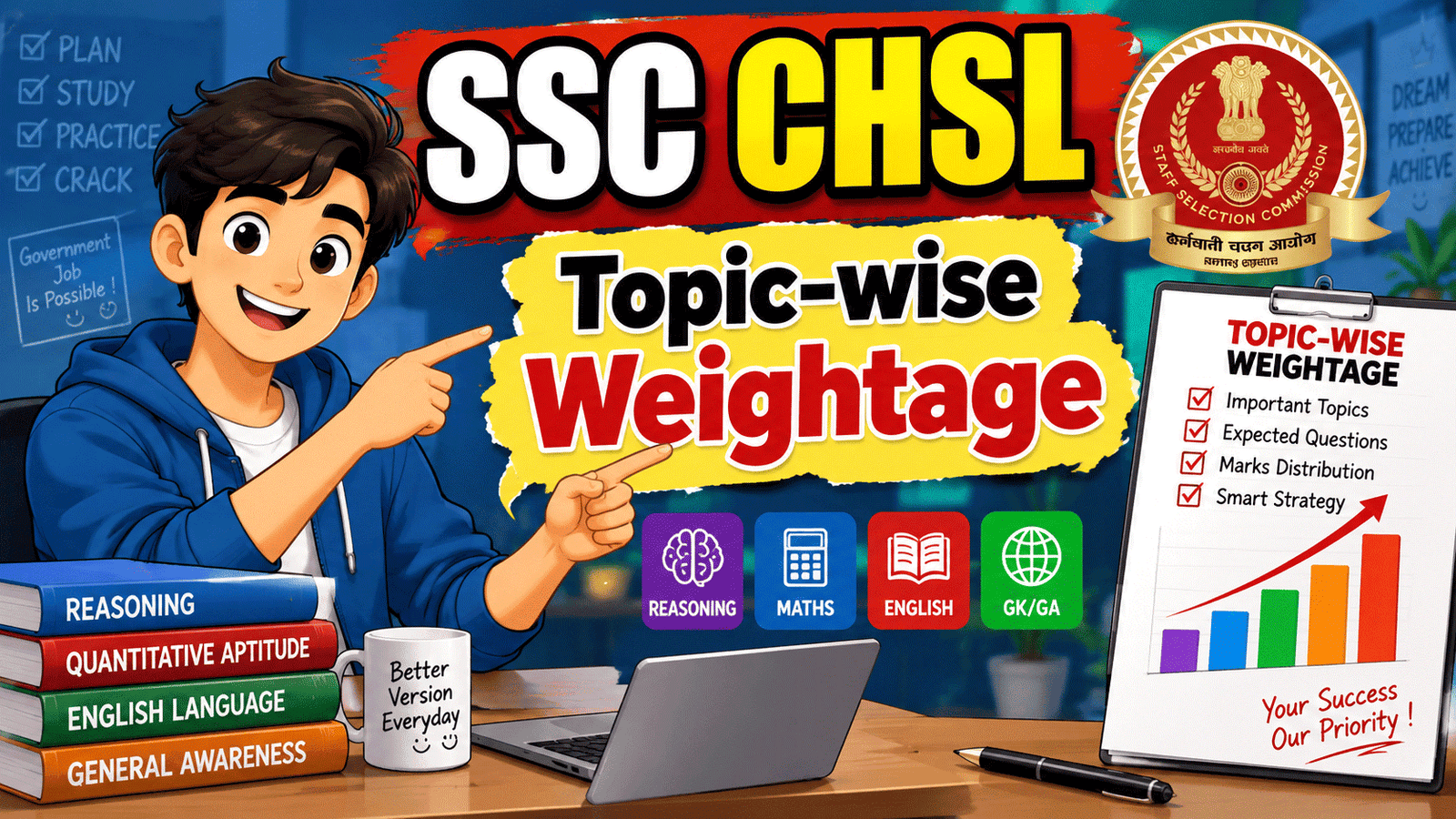
SSC CHSL Topic-wise Weightage
The SSC CHSL Topic-wise Weightage helps candidates identify the subjects and topics that generally carry more questions in the examination. For Tier-I, the paper is divided into English Language, General Intelligence, Quantitative Aptitude, and General Awareness, with 25 questions from each section. The exact number of questions from individual topics can vary from one shift to another.
English Language
- Reading Comprehension — 5–6 questions
- Cloze Test — 5 questions
- Error Spotting — 2–3 questions
- Fill in the Blanks — 2–3 questions
- Synonyms & Antonyms — 2–3 questions
- Idioms & Phrases — 2 questions
- One Word Substitution — 2 questions
- Spelling — 2 questions
- Active & Passive Voice — 2 questions
- Direct & Indirect Speech — 2 questions
General Intelligence
- Analogy — 2–3 questions
- Classification — 2–3 questions
- Series — 2–3 questions
- Coding-Decoding — 2–3 questions
- Venn Diagram — 1–2 questions
- Blood Relations — 1–2 questions
- Syllogism — 1–2 questions
- Mathematical Operations — 1–2 questions
- Mirror & Water Images — 1–2 questions
- Figure-based Questions — 2–3 questions
Quantitative Aptitude
- Data Interpretation — 2–5 questions
- Percentage — 1–2 questions
- Profit & Loss — 1–2 questions
- Ratio & Proportion — 1–2 questions
- Average — 1–2 questions
- Time, Speed & Distance — 1–2 questions
- Time & Work — 1–2 questions
- Simple & Compound Interest — 1–2 questions
- Algebra — 2–3 questions
- Geometry — 2–3 questions
- Mensuration — 2–3 questions
- Trigonometry — 1–2 questions
General Awareness
- Current Affairs — 4–6 questions
- General Science — 3–5 questions
- History — 2–3 questions
- Geography — 2–3 questions
- Polity — 2–3 questions
- Economics — 1–2 questions
- Static GK — 3–5 questions
 Download Image
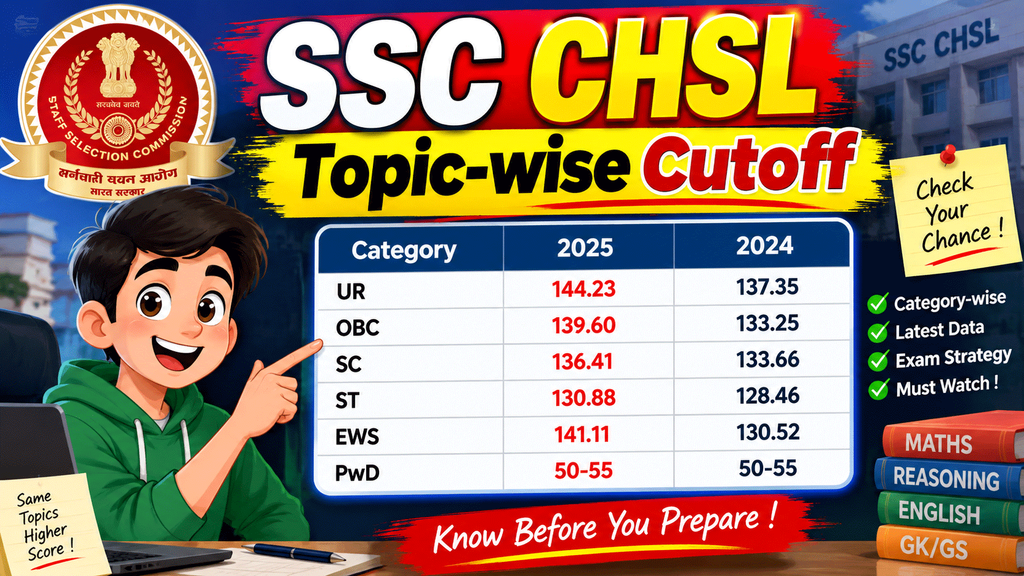
SSC CHSL Topic-wise Cutoff
| Category | 2025 | 2024 |
|---|---|---|
| UR | 144.26 | 157.36 |
| OBC | 139.68 | 153.25 |
| SC | 136.41 | 139.68 |
| ST | 130.58 | 129.45 |
| EWS | 141.11 | 150.52 |
| PWD | 50–55 | 50–55 |
SSC CHSL Last Year Paper
- SSC CHSL 2024 Question Paper PDF
- SSC CHSL 2023 Question Paper PDF
- SSC CHSL 2021 Question Paper PDF
- SSC CHSL 2020 Question Paper PDF
- SSC CHSL 2019 Question Paper PDF
- SSC CHSL 2018 Question Paper PDF
- SSC CHSL 2017 Question Paper PDF
- SSC CHSL 2016 Question Paper PDF
SSC CHSL Books 2026
| SSC CHSL Book List |
|---|
English Language: ✦ Objective General English — S.P. Bakshi Quantitative Aptitude: ✦ Quantitative Aptitude for Competitive Examinations — R.S. Aggarwal General Intelligence & Reasoning: ✦ A Modern Approach to Verbal & Non-Verbal Reasoning — R.S. Aggarwal General Awareness: ✦ Lucent’s General Knowledge — Lucent Publication Previous Year Questions: ✦ SSC CHSL Previous Year Solved Papers — Kiran Publication Practice & Mock Tests: ✦ SSC CHSL-focused chapter-wise and full-length mock test books for regular practice |
SSC CHSL Study Plan & Time Table
SSC CHSL Frequently Asked Questions (FAQs)
1. What is the SSC CHSL syllabus 2026?
The SSC CHSL Syllabus 2026 is divided into Tier-I and Tier-II. It covers subjects such as English Language, General Intelligence, Quantitative Aptitude, General Awareness, Mathematical Abilities, Computer Knowledge, and Skill/Typing Test.
2. What subjects are included in SSC CHSL Tier-I?
SSC CHSL Tier-I consists of four subjects: English Language, General Intelligence, Quantitative Aptitude, and General Awareness.
3. How many questions are asked in SSC CHSL Tier-I?
Tier-I consists of 100 questions, with 25 questions from each of the four sections.
4. What topics are covered in SSC CHSL English syllabus?
The English syllabus includes topics such as Reading Comprehension, Cloze Test, Error Spotting, Fill in the Blanks, Vocabulary, Synonyms, Antonyms, Idioms & Phrases, One Word Substitution, Active and Passive Voice, and Direct and Indirect Speech.
5. What topics are included in SSC CHSL Quantitative Aptitude?
The Quantitative Aptitude syllabus covers Number Systems, Arithmetic, Algebra, Geometry, Mensuration, Trigonometry, Statistical Charts, and other mathematical concepts prescribed by SSC.
6. What is included in the SSC CHSL General Intelligence syllabus?
General Intelligence includes Analogy, Classification, Series, Coding-Decoding, Venn Diagrams, Syllogism, Blood Relations, Mathematical Operations, Non-Verbal Reasoning, and Figure-based questions, among other topics.
7. What topics are covered under General Awareness?
General Awareness broadly covers current events, history, culture, geography, economic scene, general policy, scientific research, and general knowledge related to India and its neighbouring countries.
8. Does SSC CHSL Tier-II have a different syllabus?
Yes. Tier-II includes Mathematical Abilities, Reasoning and General Intelligence, English Language and Comprehension, General Awareness, and Computer Knowledge, along with the applicable Skill Test/Typing Test.
9. Is Computer Knowledge included in the SSC CHSL syllabus?
Yes. Computer Knowledge Test is part of Tier-II and tests candidates on basic computer concepts and related knowledge.
10. Is there a Skill Test or Typing Test in SSC CHSL?
Yes. A Skill Test or Typing Test is conducted for the posts where it is applicable. The specific test depends on the post applied for.
11. Is the SSC CHSL syllabus the same for all posts?
The core written examination syllabus is largely common, but post-specific Skill/Typing Test requirements may differ depending on the post.
12. Does the SSC CHSL syllabus change every year?
SSC may modify the syllabus or examination structure through its official notification. Therefore, candidates should always check the latest SSC CHSL notification before beginning their preparation.
13. Is General Knowledge and Current Affairs included in SSC CHSL?
Yes. General Awareness includes current events along with static areas such as history, geography, culture, economics, polity, and scientific developments.
14. Are SSC CHSL previous-year questions useful for syllabus preparation?
Yes. Previous-year questions help candidates understand frequently tested topics, question patterns, difficulty level, and the practical distribution of questions across different sections.
15. Is there negative marking in SSC CHSL?
Yes. Negative marking is applicable in the objective-type examinations, so candidates should consider accuracy along with speed while preparing for the exam.

1 thought on “SSC CHSL Syllabus 2026 PDF Download”