
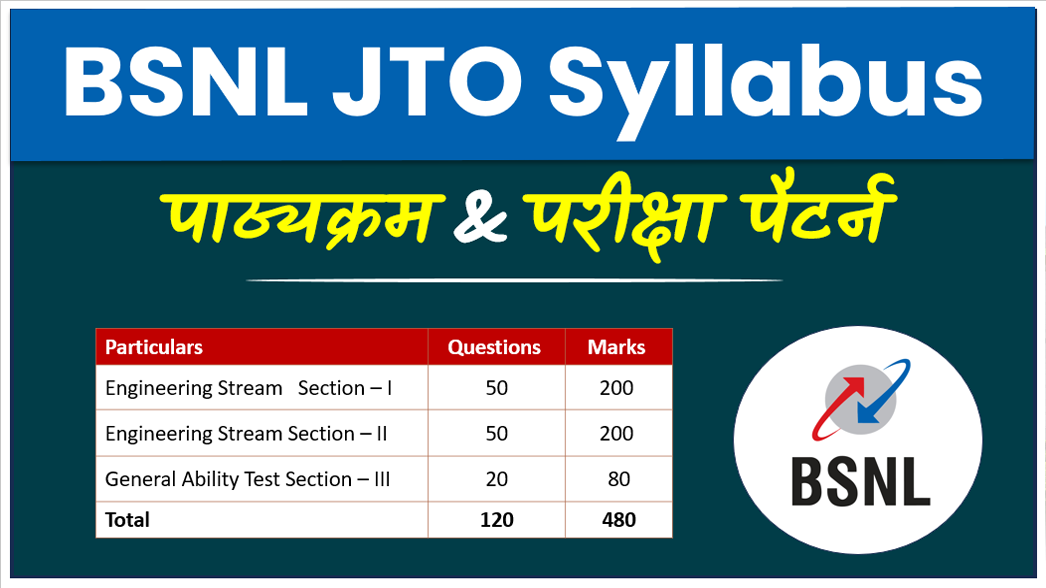
BSNL JTO Syllabus 2026: BSNL JTO Syllabus 2026 is divided into three tiers. Tier I Engineering Stream Section – I consists of 200 Marks (50 questions), Tier II Engineering Stream Section – II consists of 200 Marks (50 Questions), and Tier III General Ability Test Section – III consists of 80 Marks (20 Questions). The examination will be conducted in ONE shift comprising of three sectional papers Engineering Stream Section – I, Engineering Stream Section – II and General Ability Test Section – III for 3 hours duration.
BHARAT SANCHAR NIGAM LIMITED has released the application form for the JTO post. The official website of BSNL JTO Recruitment 2026 Syllabus is https://externalexam.bsnl.co.in/. Candidates who have filled the application form for recruitment to the post of BSNL JTO should have complete information about the BSNL JTO Syllabus 2026. If the candidate has complete information about the BSNL JTO Syllabus, then he can make his exam strategy according to the syllabus.
If you are serious about the exam, then you should have complete information about the BSNL JTO Recruitment 2026 Syllabus in detail, because many candidates do not know till the time of the examination how many questions will be asked from which subject or how many questions will be asked from which topic. If you are serious about the exam, then you must solve BSNL JTO Previous Year Question Papers.
If you solve the BSNL JTO previous year question paper, then you will know what type of questions have been asked in previous years, based on which you can make your exam strategy. Apart from this, you will know in which topic you have good preparation and which topic you need to read well. All candidates must solve the previous year’s question paper about 15 days before the exam.
Complete information about the BSNL JTO Syllabus is given in detail in this article. Candidates who want to download the official PDF of the BSNL JTO Exam Syllabus 2026. Download the BSNL JTO Syllabus PDF from the download link given below. Apart from the information given in this article, if the candidate wants to get any other information related to the BSNL JTO ka syllabus 2026, then they can ask their questions through the Facebook Messenger given below, and students can ask their questions in the comment box.
BSNL JTO Syllabus 2026 Exam Overview
- Name of the Examination – BSNL JTO Recruitment 2026
- Organizing Authority / Conducting Body – BSNL
- Level of Examination – National Level
- Post Name – Junior Telecom Officer (Telecom)
- Salary – Rs. 16400– ₹ 40500/-
- Educational Qualification – B. Tech/ B.E Pass
- Age Limit – 20-30 Years
BSNL JTO Syllabus 2026 Selection Process
The examination (computer-based, multiple-choice, objective-type test) will consist of one paper as given below:
- Engineering Stream Section – I
- Engineering Stream Section – II
- General Ability Test Section – III
BSNL JTO Syllabus 2026 Exam Pattern
| Particulars | Questions | Marks |
|---|---|---|
| Engineering Stream Section – I | 50 | 200 |
| Engineering Stream Section – II | 50 | 200 |
| General Ability Test Section – III | 20 | 80 |
| Total | 120 | 480 |
| Duration | 3 hours | |
| Qualifying Marks | Minimum Qualifying Marks in each Section shall be 35% and overall minimum Qualifying Marks in all three section combined shall be 45%. | |
BSNL JTO Syllabus 2026
BSNL JTO Syllabus 2026: Engineering Stream Section – I
- Materials and Components: Structure and properties of Electronic Engineering materials, Conductors, Semiconductors and Insulators, Magnetic, Ferroelectric, Piezoelectric, Ceramic, Optical and Superconducting materials. Passive components and characteristics, Resistors, Capacitors and Inductors; Ferrites, Quartz crystal, Ceramic resonators, Electromagnetic and Electromechanical components.
- Physical Electronics, Electron Devices and ICs: Electrons and holes in semiconductors, Carrier Statistics, Mechanics of current flow in a semi-conductor, Hall effect; Junction theory; Different types of diodes and their characteristics; Bipolar Junction transistor; Field effect transistors; Power switching devices like SCRs, CTOs, power MOSFETs; Basics of ICs-bipolar, MOS and CMOS types; Basics of Opto Electronics.
- Network theory: Network analysis techniques: Network theorem, transcient and steady state sinusoidal response, Transmission criteria: delay and rise time Elmore’s and other definition, effect of cascading. Elements of network synthesis.
- Electromagnetic Theory: Transmission lines: basic theory, standing waves, matching applications, microstrip lines; Basics of waveguides and resonators; Elements of antenna theory.
- Electronic Measurements and instrumentation: Basic concepts, standards and error analysis; Measurements of basic electrical quantities and parameters; Electronic measuring instruments and their principles of working: analog and digital, comparison, characteristics, applications. Transducers; Electronic measurements of non-electrical quantities like temperature, pressure, humidity etc. Basics of telemetry for industrial use.
- Power Electronics: Power Semiconductor devices, Thyristor, Power transistor, MOSFETs, Characteristics and operation. AC to DC convertors; 1-Phase and 3-phase DC to DC Convertors. AC regulators. Thyristor controlled reactors, switched capacitor networks. Inverters: Single-phase and 3-phase. Pulse width modulation. Sinusoidal modulation with uniform sampling. Switched mode power supplies.
BSNL JTO Syllabus 2026: Engineering Stream Section – II
- Analog Electronic Circuits: Transistor biasing and stabilization, Small Signal analysis. Power amplifiers. Frequency response, Wide band techniques, Feedback amplifiers. Tuned amplifiers. Oscillators. Rectifiers and power supplies. Operational Amplifier, other linear integrated circuits and applications. Pulse shaping circuits and waveform generators.
- Digital Electronic Circuits: Transistor as a switching element; Boolean algebra, simplification of Boolean functions, Karnaugh Map and applications; IC Logic gates and their characteristics; IC logic families: DTL, TTL, ECL, NMOS, PMOS and CMOS gates and their comparison; Combinational logic circuits; Half adder, full adder; Digital Compartor; Multiplexer Demultiplexer; ROM and their applications. Flip-flops, R-S, J-K, D and T flip-flops; Different types of counters and registers; waveform generators. A/D and D/A convertors, Semiconductor memories.
- Control Systems: Transient and steady state response of control systems; Effect of feedback on stability and sensitivity, Root locus techniques; Frequency response analysis. Concepts of gain and phase margins; Constant-M and Constant-N Nichol’s Chart; Approximation of transient response from Constant-N Nichol’s Chart; Approximation of transient response from closed loop frequency response; Design of Control Systems, Compensators; Industrial controllers.
- Communication systems: Basic information theory: Modulation and detection in analogue and digital systems; Sampling and data reconstruction. Quantization & Coding; Time division and frequency division multiplexing; Equalisation; Optical Communication: in free space & fibre optic; Propagation of signals at HF, VHF, UHF and microwave frequency; Satellite communication.
- Microwave Engineering: Microwave Tubes and solid state devices, Microwave generation and amplifiers, Waveguides and other Microwave Components and Circuits, Microstrip circuits, Microwave antennas, Microwave Measurements, MASERS LASERS; Microwave Propogation. Microwave Communication Systems-terrestrial and satellite based.
- Computer Engineering: Number Systems; Data representation; Programming; Elements of a high level programming language PASCAL/C; use of basic data structures; Fundamentals of computer architecture processor design; Control unit design; Memory organization. I/O System Organization. Personal computers and their typical uses.
- Microprocessors: Microprocessor architecture – Instruction set and simple assembly language programming. Interfacing for memory and I/O. Applications of Microprocessors in Telecommunications and power system.
BSNL JTO Syllabus 2026: General Ability Test Section – III
- General Ability Test: The candidate’s comprehension and understanding of General English shall be tested through simple exercises. Questions on knowledge of current events and of such matter of everyday observation and experience in their scientific aspects as may be expected of an educated person. Questions will also be included on events and developments in Telecommunications, History of India and Geography. These will be of a nature, which can be answered without special study by an educated person.
BSNL JTO Syllabus 2026 Apply Online Link
| Events | Links |
|---|---|
| Syllabus | Click Here |
| Notification | Click Here |
| Maths Notes 📈 | Download💥 |
| GK/GS Notes✍️ | Download |
| Daily Latest Jobs 🚀 | Click Here |
| Resume Templates 👉 | Download Resume |
| Join Our WhatsApp Group | Join Here |
| Join Our Telegram Group | Join Here |
| Age Calculator🕘 | Check Age Limit |
